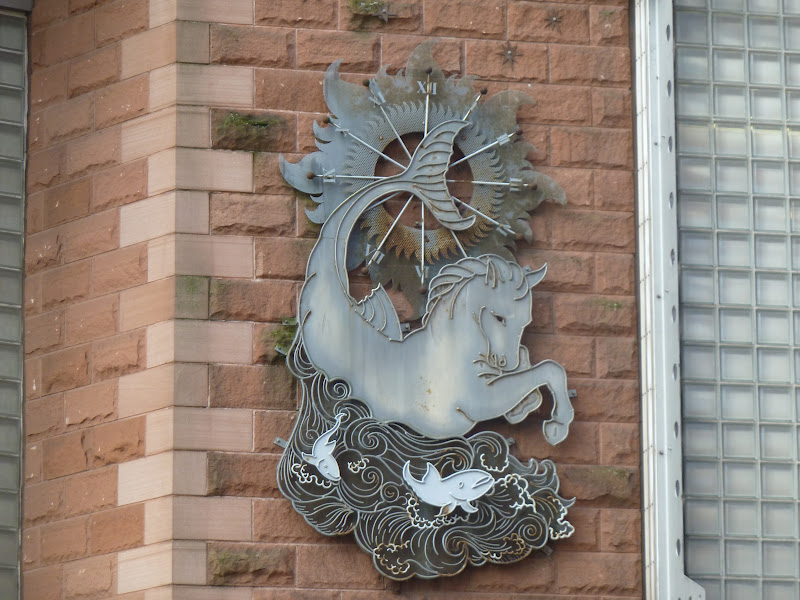
We start of Part 3 of our exploration of Glasgow's clocks in the morning rain. The first stop is St Enoch Square, and the delightful building that was constructed for the underground railway. It was built in 1896, as evidenced by the date underneath the clock.
The building has now, unfortunately, been given over to retail use which adds a layer of vulgarity, but it still retains its overall charm. And most importantly for this blog, the clock is well-maintained and keeps good time.
Keeping with the transport theme, the next stop is Glasgow Central railway station just a little further west on Argyle Street.
This is a nice clear, keeping good time clock over the busy concourse. It is a nice feature, but you do wonder how many people use it to tell the time when the digital indicator boards are so close by. At least it is indoors, so I didn't have to get wet taking the photograph (although trying not to be bowled over by the tidal wave of commuters was a different matter).
We are on a roll with transport-related clocks, so a quick change of mode and a move northwards to Buchanan Bus Station. Outside is the "running man" clock, a tall sculpture in the shape of two legs with a cuboid clock on top. Full marks for the artistic intention, but a big fat zero for having a clock that doesn't work, especially as knowing the right time would be useful if you were running for a bus. Incidentally, the sculpture is running away from, and not to, the bus station - I am not sure if there is any deep message behind this (probably not - it's more likely to be a planning regulation thing).
Inside the bus station is a different matter altogether. One end wall of the concourse has this enormous clock.
This is one of my favourite clocks in the city, as the size and simplicity of design makes it easy to read, and it shows the correct time. Although not the most beautiful of clocks, it serves it purpose perfectly and fits in well with its surroundings.
The next clock moves away from the direct transport theme, but there is still a link. This is H Samuel jewellers in the St Enoch centre. The link is not that you are transported away into a land of gold, silver and diamonds, but that the shopping mall is on the site of the old St Enoch railway station, demolished in 1977. As shopping malls go this is not too awful, but I waited until the security guards moved on before taking the picture as they can get quite funny about these things.
Back outside to the grey skies of Glasgow, and on to St Vincent Place. This is a rather unusual arrangement of two clock faces on the frontage - normally there would be either a single face, or two faces back-to-back at right angles to the main building. I have no idea why this particular design was chosen.
Whatever the reason for the design, the time in this street seems to be permanently stuck at 9.52.
Ah, blue skies again! This is the St Paul's building of the University of Strathclyde, on the junction of John Street and Martha Street.
And finally, for this part of the Glasgow jaunt, to the Holiday Inn on West Nile Street / Renfrew Street.
A relatively small clock high up on the West Nile Street frontage.
But things are much worse on the Renfrew Street side, where the clock has disappeared altogether:
A random look at public clocks in Britain, covering those on shops, public buildings, railway stations etc.
Sunday, 14 October 2012
Thursday, 4 October 2012
Glasgow - Part 2
And so on to more clocks in Glasgow....
First stop, the Ramshorn Theatre in Ingram Street.
This is the view from the windows of the Premier Inn, looking across the graveyard to the back of the building. A graveyard? A church-like tower? No surprises that this was originally St David's church (also known as Ramshorn Kirk) of 1824-26.
A blue plaque provides further proof of this:
The next clock is to be found on the premises of Carmichael Solicitors, on the junction of High Street and Duke Street.
A much more modern building, of 1985, on the corner of Trongate and Stockwell Street include this simple clock. Clearly this part of Glasgow likes to get ahead of the change back to GMT as it was almost exactly an hour slow.
Up to Royal Exchange Square off Queen Street. No prizes for guessing that the imposing building which is now the Gallery of Modern Art (GoMA) was once the Royal Exchange. The clock faces on the different sides of the tower considerably different in design, and are quite difficult to photograph from street level due to the tight nature of the site.
The clocks in this posting are in a random order. If you try to see the clocks in the order that I have shown them here you either would be quite mad or an exercise freak as you would be walking a lot of unnecessary miles.
So next up for no logical reason is the People's Palace in Glasgow Green (from which you will know from Part 1 you can see the clocks on St Andrews and the Merchant's Steeple).
The building was constructed in 1893-98, and includes some fascinating exhibitions on Glasgow life.
The clock is on the rear of the main building, facing into the botanical garden. The staircase towers and the balcony on which the clock sits are later additions to the building of 1988 - 90.
I assume that this filled-in opening on the rear of the balcony was the clock's original location.
Finally for this posting, we are off the the other end of Stockwell Street, and to the local branch of Argos.
This looks like a clock in that it has the numerals I to XII in the usual circular clockwise pattern, but closer inspection reveals that there are no hands. An identical sculpture on the adjacent wall, but this time with weather-vane type features, would seem to confirm that the "clock" is purely a decorative feature. But hey-ho, it is a nice feature, and not what you would normally expect on a branch of Argos.
For more Glasgow clocks (and clock-like features that are not really timepieces unless they are incredibly cunning in the way they portray time) you will have to wait until Part 3.
Monday, 1 October 2012
Glasgow - Part 1
This is the first trip north of the border into Scotland for this blog. This posting for Glasgow follows the pattern for those of other large cities, and will be broken down into several parts.
Part 1 starts with the area of the city centre known as the Merchant City. First off is the marvellous but slightly mad Tolbooth Steeple, a real landmark at the junction of High Street and Trongate. Built in 1625-27, it was originally part of city gateway. The clock has a very simple and clear face in blue and gold which is visually impressive and easy to read, and more importantly keeps the right time.
Impressive on its own, but just around the corner is the Tron Steeple which has a very European feel to it, especially its pink colouring. The steeple is now part of the Tron Theatre on Trongate. Once again, a very simple but impressive and effective clock-face design, and also keeping true time.
These two clock steeples are worth a visit to Glasgow on their own. But we have plenty of other clocks to see.
The next example is on Hutcheson's Hall on Ingram Street (not surprisingly opposite the end of Hutcheson Street), built in 1802-05. Unlike the two steeples, this is more of a proper building with a clock tower, but lets itself down by having a stopped clock.
The theme so far seems to be big pointy things with blue clocks. So lets have some more....
This is St Andrews parish church, or St Andrews in the Square, of 1739-56. A great tower with a clockface in good condition. Unfortunately the time seems to be stuck at 12.12.
The clock on St Andrews can be clearly seen from Glasgow Green (which we will return to in a later posting), as can our next clock on Merchant's Steeple. This tower of 1665 continues the blue and gold theme, and is one of the most useful stopped clocks in Glasgow - its four faces all show a different time, so it is right eight times a day!
Enough of big pointy things with blue clocks. Here's a big pointy thing with a white clock:
This is the tower of the Royal Infirmary, but as you can see it is not a timepiece to rely upon. A good excuse for being late for your out-patient's appointment I suppose.
And so the the end of Part 1. More clocks of Glasgow coming soon in Part 2.
Saturday, 29 September 2012
Royal Courts of Justice
Perhaps pushing the boundaries of what can be called a public clock, I have included some pictures taken at the Royal Courts of Justice in The Strand, London, during last weekend's Open House London (see www.openhouselondon.org.uk).
The building is by the architect George Edmund Street, and is in the Victorian Gothic Revival style. The Great Hall is cathedral-like in both its size (70 m long, 15 m wide and 25 m high), and makes the substantial clock at its northern end seem lost.
There are numerous other clocks around the building, including a standard design in each of the many courtrooms (where photography is banned). The clock below is on one of the upper corridors surrounding the Great Hall.
The above two clocks are both by Gillett & Co of Croydon. The company was established in 1844, although only became known this name in 1884. Subsequently the company has become Gillett & Johnston and is still in existence, although it moved out of Croydon this year. Further details are on the company's website at www.gillettjohnson.co.uk.
The following clocks are in the more ornately decorate parts of the building, nesting amongst the fine wallpapers and polished marble......
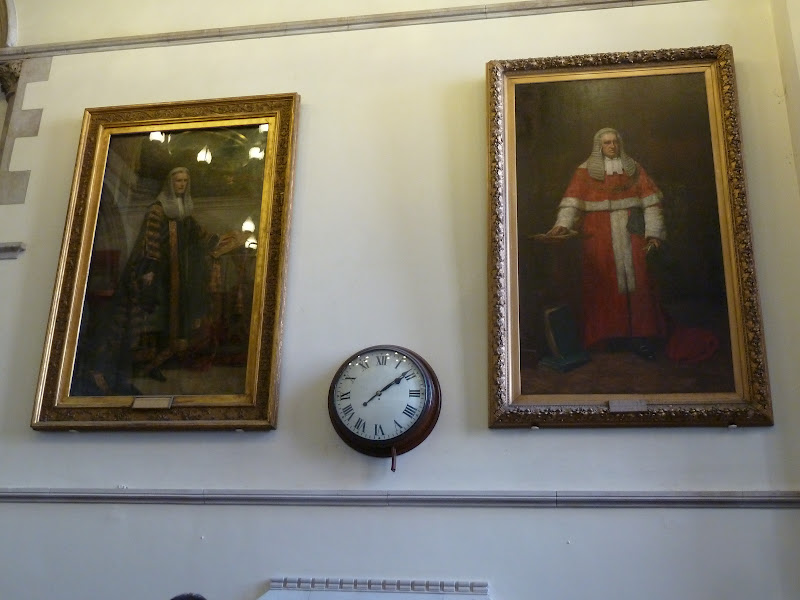
...or between portraits of the great and good in the legal world.
Friday, 7 September 2012
Enfield
A look at Enfield town (rather than the whole London borough). The compact town centre has a nice range of clock types.
The first example is on Church Street. This, as you can clearly see, is Gordon Thomas opticians. A well-maintained clock. The time was right on this face, but the other face seems to be showing the wrong time when I went back past it over two hours later.
Nestling behind the market on Church Street (which includes the branch of Barclays Bank which opened the world's first ATM in 1967) is the church of St Andrew's.
The clock face is a very simple but clear and effective one by JW Benson of London.
Further along Church Street is this barrel clock on what is now a branch of Prezzo. A very attractive addition to the streetscape, but unfortunately not working. The clock design, and the building itself, would suggest that this was originally a coaching inn.
Across the road to what is still a pub, and to a clock that is working. No prizes for guessing that this is The George pub.
Just round the corner on London Road you can find this clock on a jeweller's shop. I won't embarrass the shop in question as the clock is not working (but helpfully shows a different time on each face).
I have never thought that it is a good advert for a jeweller's to have a stopped clock, but perhaps not many people take notice of public clocks these days.
Moving north onto Silver Street, and to the premises of Blake and Horlock funeral directors. This clock is working, but shows completely the wrong time, and a different time on each face. I suppose time doesn't matter to their ultimate clients, or perhaps it is always later than you think.
Subscribe to:
Posts (Atom)