Friday, 28 February 2014

Northcliffe House

I have passed this building on Kensington High Street on many occasions, but have only just noticed the clocks on the side road facades. It just goes to show how easy it is to miss even quite big details, especially when navigating the crowds on a busy Saturday.


Northcliffe House is the home of the newspaper publishers the Daily Mail and General Trust plc. the entrance is on Derry Street, above which is an "Evening Standard" clock. the building is named after Baron Northcliffe who, as Alfred Harmsworth, co-founded the Daily Mail newspaper in 1896. The company move to this location in 1988.


Northcliffe House forms the back of the former Barkers store which faces onto Kensington High Street. It was built in 1904, with substantial remodelling in 1938.


The Evening Standard was sold in 2009, which probably explains why the lettering is only in trace form.


The other side of the building fronts onto Young Street. Here the newspaper name is prominently displayed above and below the clock.


Monday, 10 February 2014

The Royal Mews

The Royal Mews are where the horses, state carriages and motor cars of the royal household are kept, and form part of Buckingham Palace. The entrance, not all that surprisingly, is on Buckingham Palace Road.


The clock tower itself was added in 1824.


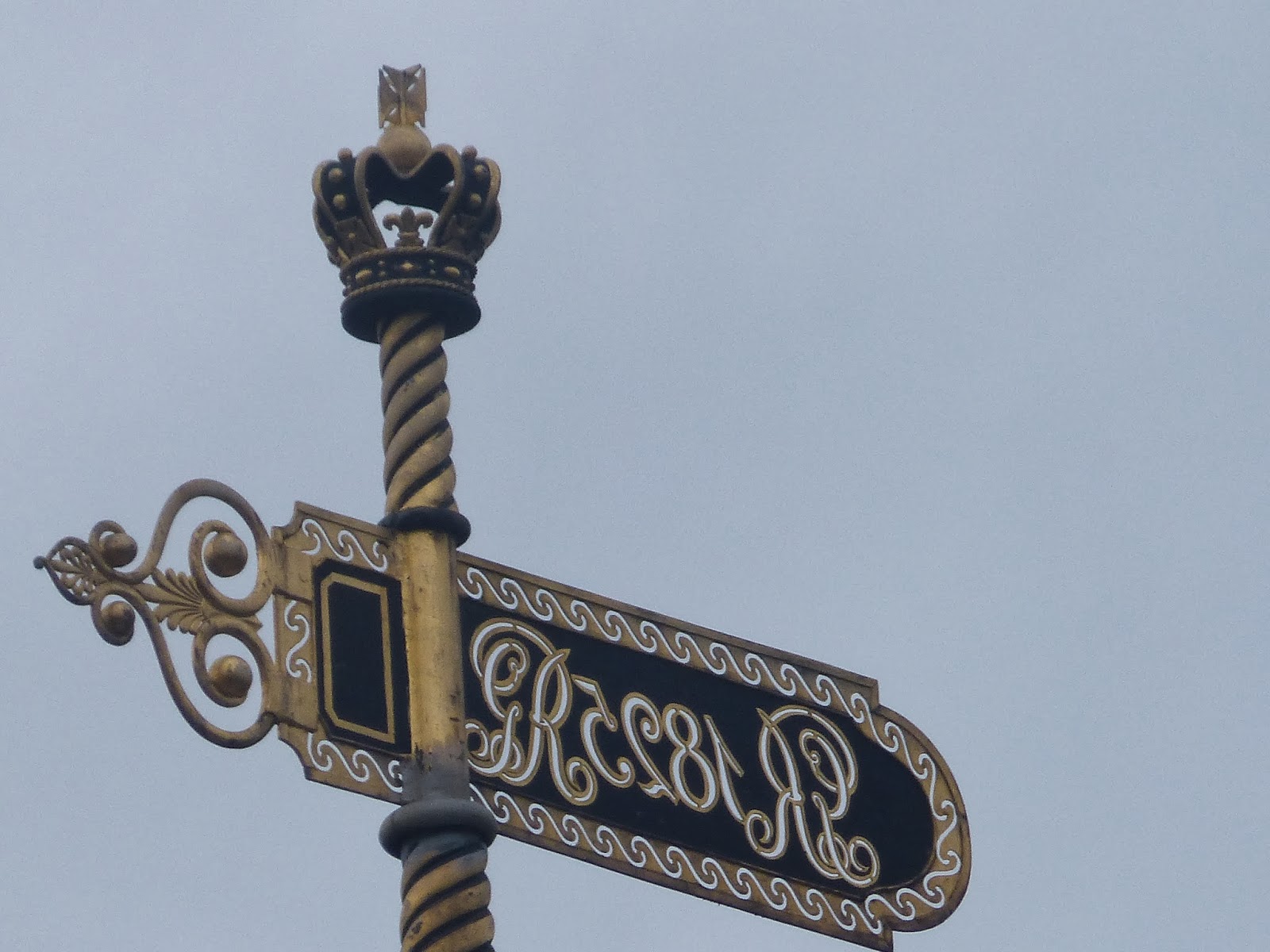
Not only a clock, but quite a fancy weather vane too.


The Mews are protected by the Lion and the Unicorn.


Sunday, 2 February 2014

Fleet Street (Londonopoly #6)

Fleet Street is the traditional home of the British press, where all the major newspapers were located. The first printing press was established in 1500 by Wynkin de Worde, but by the late 1980s the newspapers had decamped to modern printing presses and office blocks throughout London.

It is also famous for having a barber's shop with the proprietor going by the name of Sweeney Todd - the demon barber of Fleet Street.

Fleet Street gets its name from the Fleet River, one of London's "lost" rivers which lies buried beneath the streets and flows north - south at the eastern end of Fleet Street.

Our first location is 187 Fleet Street, assuming that the legend beneath the clock is correct.


Next stop, a clock with a background view which points to the press heritage of the street. This is the church of St Dunstan-in-the-West.


There has been a clock here since 1671, although the present one dates from 1738. When the old church was demolished in 1830 the clock was sold and removed to the Marquess of Hertford's villa St Dunstan's Lodge. Over one hundred years later it was returned to the church, being officially unveiled on 24 October 1935.


Behind the clock are these two figures which strike the bells.

 
The clock and its figures are on the east side of the church tower, which a scan be seen has its own clock.


Two doors down is this more modern office building.


And further down the street, this office building with its stopped clock.


The old Daily Telegraph building of 1928 is an architectural gem in a style that the "Guide to the Architecture of London" describes as jazz modern.

The large clock is quite bonkers in its design, and as a result is quite magnificent.


Our last stop is Ludgate House, located at Ludgate Circus which marks the end of Fleet Street.


In Londonopoly terms, it is seven clocks for £220, or £31 per clock.
 
Previous postings in this series:
Bond Street - 4 August 2013
Oxford Street - 30 November 2013
Regent Street - 4 January 2014
Trafalgar Square - 13 January 2014
Strand - 22 January 2014
 

Wednesday, 22 January 2014

Strand (Londonopoly #5)

Strand (note, not The Strand) runs from Trafalgar Square to Fleet Street, running up to the boundary of the City of London.

Strand forms part of an ancient road - it was part of the Roman road Akeman Street, and in 1002 was referred to as strondway. The word strand means shore, a reflection of the fact that this route was originally the north bank of the Thames.

There are at least three clocks on side roads just off Strand but I have not included them here as that would be cheating on the Londonopoly theme. I have included the clocks in the central courtyard of Somerset House on the Strand, but not the one in Charing Cross station (I never claimed to be consistent).

Also not included is Shell Mex House, which is technically on the Strand, but whose huge clock cannot be seen from this road.

First stop (and stopped it certainly is) is the Civil Service Supply Association Ltd clock.


It is a shame that this isn't working as it is one of my favourite London clocks because of its simple design, Arabic numerals rather than the all too common Roman ones, bright blue border, large size, and prominent position on a plain yet elegant wall.


Further down, on the same side of the road, is the Lyceum Tavern with its barrel clock.


A quick diversion into the entrance to the Somerset House courtyard, with its clock towers on the eastern and western blocks.


And now for two splendid churches, both now situated in traffic islands in the middle of the road. The first is St Mary le Strand. Completed in 1717, this church was designed by James Gibbs, who was also responsible for St Martin-in-the-Fields in Trafalgar Square.


The second church is St Clements Dane - Oranges and lemons say the bells of St Clement's (see Londonopoly #4). Incidentally the fruit connection of Strand is continued in the old music hall song "Let's All Go Down The Strand" with the memorable lines 'Let's all go down the Strand - Have a banana!'.


The church dates from 1680 and is by Sir Christopher Wren. However, if you thought that the tower looked similar to that of St Mary le Strand you would be right, as it is a later edition of 1720 by James Gibbs.


Finally, but most magnificently, is the clock on the Royal Courts of Justice.


It looks particularly good on a sunny day, but in any weather the ornamentation on this timepiece is superb.


This has to be in my top five of clocks in the country.


The building itself was opened by Queen Victoria in December 1882, and is often referred to as the last great Gothic public building in London. Some of the clocks inside the building are included in my posting of 29 September 2013.


So, time for the final Londonopoly reckoning. Excluding Somerset House, it is five clocks for £220 and hence £44 per clock.
 
Previous postings in this series:
Bond Street - 4 August 2013
Oxford Street - 30 November 2013
Regent Street - 4 January 2014
Trafalgar Square - 13 January 2013