Showing posts with label M&S. Show all posts

Friday, 29 March 2024

Cheltenham - Part 1

Cheltenham is perhaps best known for its race course and for being the home of GCHQ, but it is now time to put in on the map for its clocks.

A high proportion of the clocks are on ecclesiastic or educational establishments, which may or may not say something about the good people of the town. But nevertheless there is a good range of public timepieces to be seen.

The order of the clocks in this post is roughly in the order in which the pictures were taken rather than trying to provide a sensible route to see them all in a day's visit. And unusually we don't start with the railway station as unfortunately it is devoid of any clocks (or at least ones which would make it into this blog).

In fact our starting point is a clock that can't really be seen at the moment - in the sense that it is currently obscured by scaffolding rather than having magically turned invisible.


Hopefully by the time you track it down it will be fully visible. And if you do want to track it down, let me make it easier by telling you that this Francis Close Hall in Swindon Road - part of the University of Gloucester.

Not far away is St Paul's church:


Thus Grade II* church was designed by John Forbes and was built in 1829 - 31.


It is getting rarer to find Marks & Spencer on the High Street these days as it has shifted focus to out of town sites (and by all accounts doing much better financially out of the strategy). However the High Street stores that do still exist often come adorned with the standard M&S clock, and in this regard Cheltenham does not let us down.


Further along the High Street where it is joined by Cambray Place we find this fine corner building.


I couldn't see any sign of what this building used to be, but I am pretty sure that the current street level shop was not its original purpose. My guess that it might have been a bank due to its grand nature and the fact there are other bank buildings (or generally ex-banks) nearby along the High Street.


Another church now - this time the Roman Catholic church of St Gregory the Great, located on the corner of St James' Square and Clarence Street.


The main body of the church was built 1854 - 57, although the tower and spire was not completed until 1876. The architect was Charles Hansom (1817 - 1888), who designed scores of churches across the country. And if you you think the name rings a bell, he was the brother of Joseph Hansom, also an architect but also creator of the Hansom Cab.


Sometimes buildings look like churches when they are not, and sometimes they look like churches because that was what they were originally built as but have now been re-purposed. Such is the case with Zizzi in Suffolk Square, whose structure was once St James' church.


As a church, this building was consecrated in 1830 and ceased being a place of worship in 1974. It was converted to its current restaurant use in 2004. If you looked at its lifespan to date as a pie chart, the Zizzi period would have an arc of about 36 degrees, or a thinnish slice of pizza.


From churches to colleges, we are now at Cheltenham College. The first of three clocks is on a side elevation in Sandford Road. This set back a long way from the road (see if you can spot in in the second photo) and is a relatively simple clock, and hence it can be assumed that this meant for the pupils of the school only rather than one for the general public.


The main entrance on Bath Road is far more impressive, and has a more elegant clock to match.


The college was established on this site in 1843, and the main building was designed by James Wilson of Bath.

The third clock is facing the college's sports ground.


We haven't had a look at church for a little while, so here's St Luke's, on St Luke's Road.


The church dates from 1853-54, and was designed by Frederick W Ordish of London.


Back to educational establishments, we are now at Cheltenham Ladies' College, which is much more widely known than its male counterpart. The clock is on one of its buildings on Montpellier Street, although it is best viewed between the gaps in the buildings on the Promenade.


The main site was built 1872 - 76, but the clock is on the tower of the observatory added in 1897.


We will finish off part 1 of our tour of Cheltenham by looking at three clocks on commercial premises on the Promenade, the posh shopping street of the town.

The first two are standard promotional designs for Omega and Rolex on the the Omega and Martin & Co shops respectively:


The third Promenade clock is both larger and more interesting, and also possibly doomed. This long-established department store is now part of the House of Fraser Group, and at the time of my visit (February 2024) was in the process of shutting down (who would have thought that Mike Ashley's Sports Direct Group would downgrade quality shopping?).


The original Victorian frontage was given a major makeover in the 1960's, which I assume is when this rather pleasing clock was added. Who knows what will happen to the building, but hopefully the clock will be retained.


Next stop, Part II.


Saturday, 9 May 2020

Worcester (Part 1)

Worcester was visited in July 2019 as part of my tour of Henry and Joyce Collins concrete murals. the clocks side of this visit are set out in he order I came across them over a couple of days, and so they are not necessarily in the form of a trail that efficiently visits them all. But randomness is all part of the discovery process.

Our first stop is All Saints church on Deansway - which is the first clock you come to if you walk into the city centre and you just happen to be staying at the Premier Inn at the County Cricket Ground.


Unfortunately for me, the church is not included in the "Worcester in 50 Buildings" book which I bought from the local Waterstones. So further research shows that the church has origins in the 12th century, and has included a re-build in 1739-42 and alterations by Aston Webb in 1889.


Our next clock is in Angel Place.


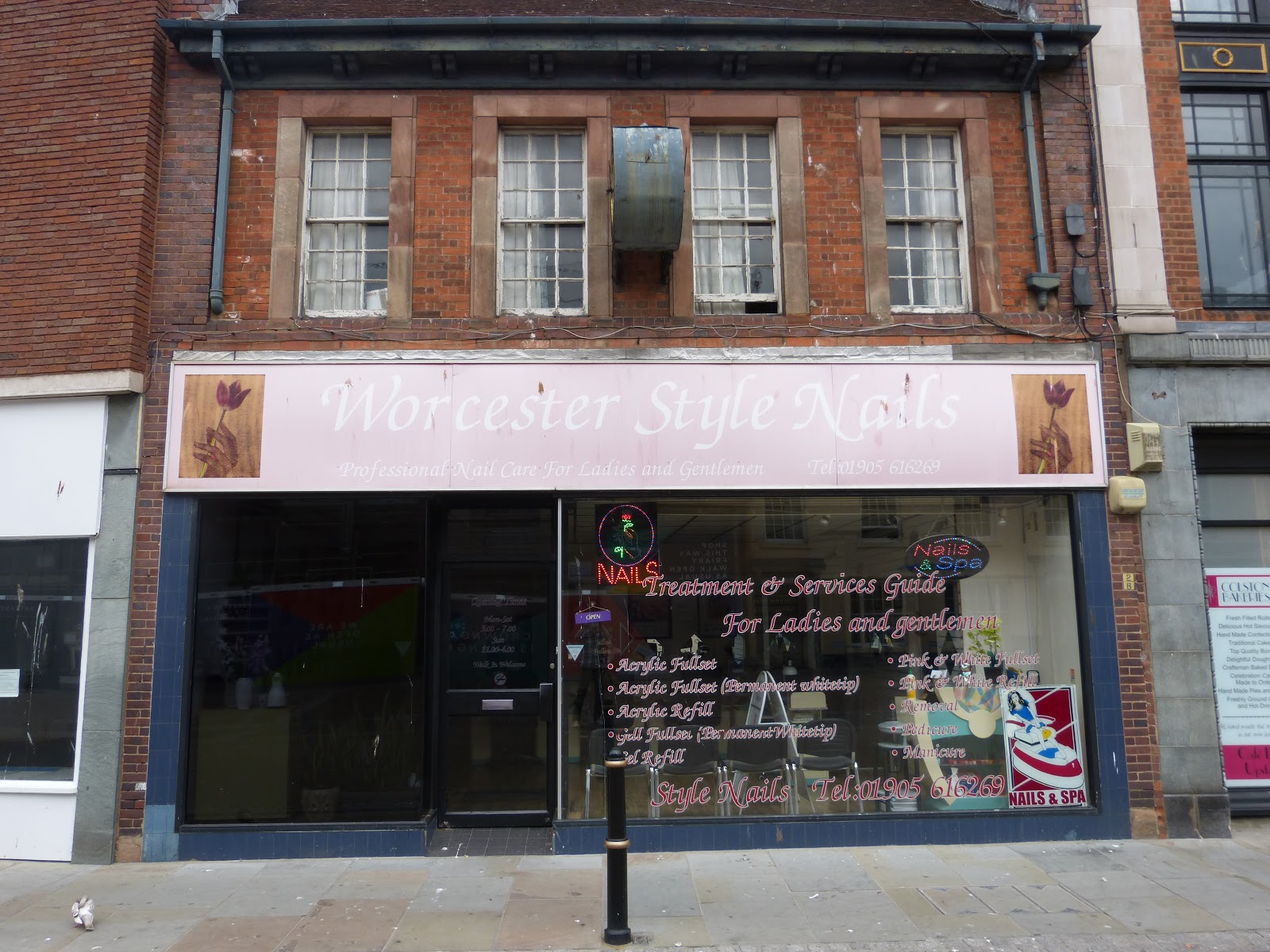
On one face you can clearly make out the words Midland Red Motor Services, which was a bus company operating under this name from 1905 to 1981. Clearly not related to the current occupiers of the building, Worcester Style Nails.


The High Street, and the other roads that it morphs into to form a continuous liner route through the centre of the city, is blessed with a number of clocks. Our first is at Ernest Jones.


The High Street becomes The Cross, and reveals the clock at what is now a branch of Subway. I think that it is fair to guess that the clock was installed by a previous occupier of the site.


The clock face appears to have been rotated such that the 12 o'clock mark is at something like three minutes past. And this is not a happy clock, stuck at 12 o'clock and with a third of its glass missing on this side.


The Cross becomes Foregate Street, and at its junction with Sansome Street we have A-Plan Insurance.


The building has both a clock and a barometer. The latter gives the clue that the building was once occupied by Friedrich Optician.


This next beautiful brick clock tower is at the junction of Shrub Hill Road and Tolladine Road.


This is the Shrub Hill Engine Works, built in 1864 to construct locomotives. It was on a complex of railway lines including the main line through Worcester Shrub Hill station and a series of branches serving local industrial premises. Locomotive building at the site only lasted until 1870, with a total of 85 engines being constructed here.


The building is now in mixed industrial use.


We are back on the High Street now, trying to get a glimpse of this church clock which is now hemmed in by subsequent development. The roadworks also didn't help in being able to get a good photograph.


This is St Swithun's church, and we will get a better view of its other clock face later on.


There has been a church on this site since 1126. Of the current building, the tower dates from the 15th century, whilst the main body of the church was rebuilt in 1736.


It is now a Grade I listed building, but has been redundant since 1977. The interior is currently being restored to become an arts venue, which is due to open in late 2020.


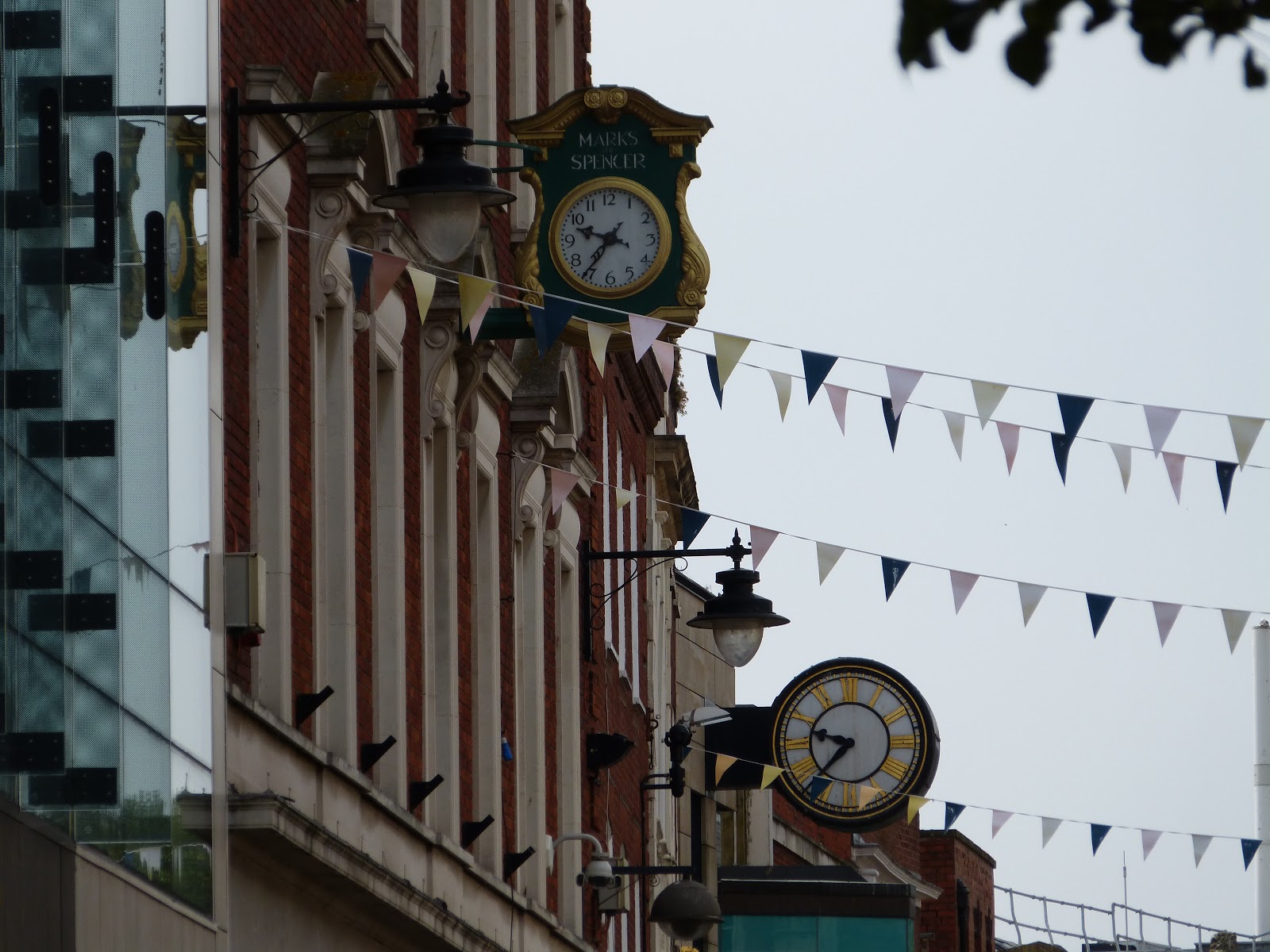
Further along the High Street we have good old Marks and Spencer, often a good bet for a clock.


Looking just along the road, there is another clock which marks the entrance to City Arcade.


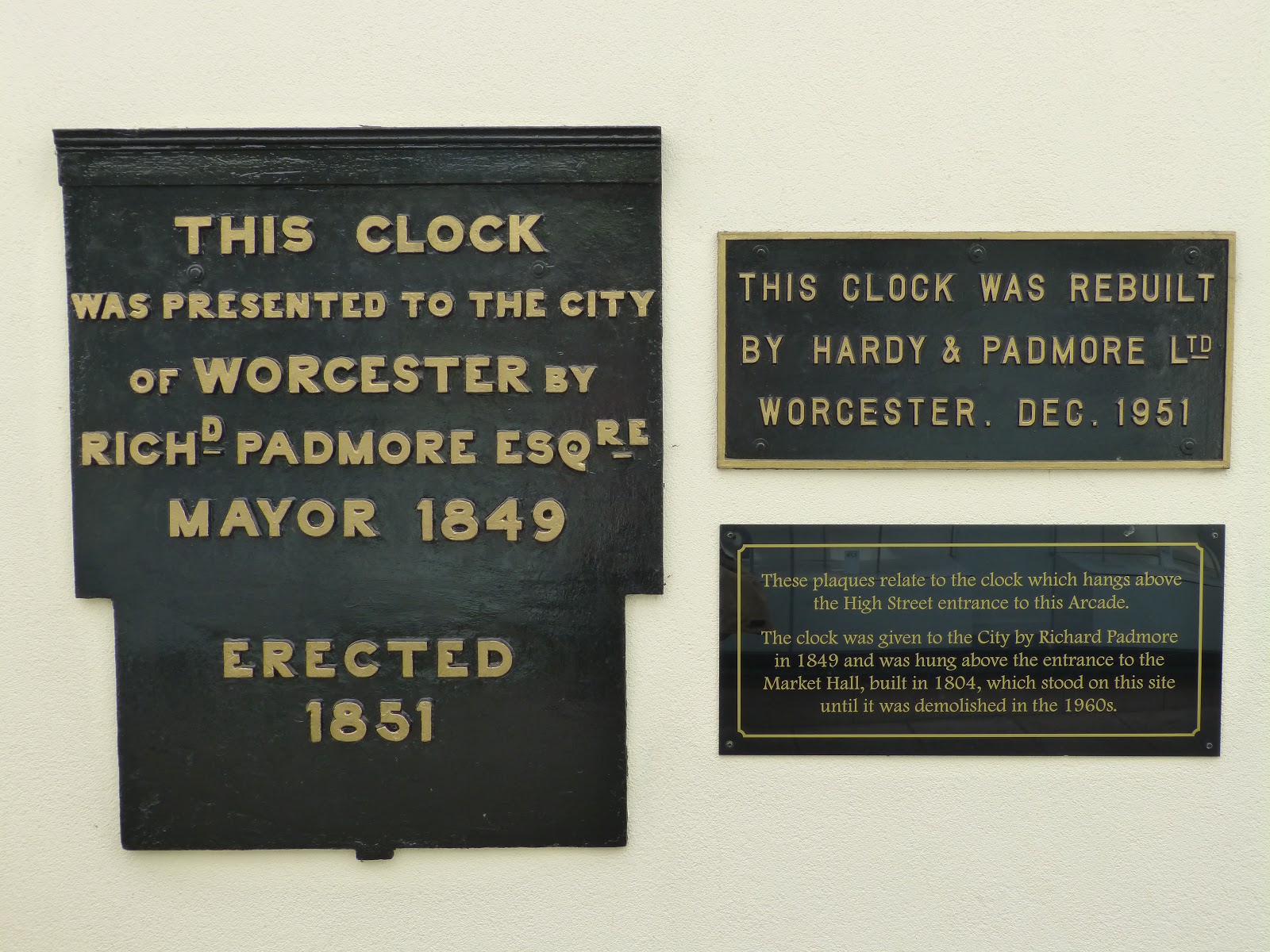
If you walk through the arcade you will find some information about the clock.


Crowngate Shopping Centre is a more modern collection of shop, opening in 1992. As shopping centres go it is not bad, and it has the saving grace of a prominent clock. The classic style works well against the brickwork and the grill.


Worcester Part 2 will be along shortly.