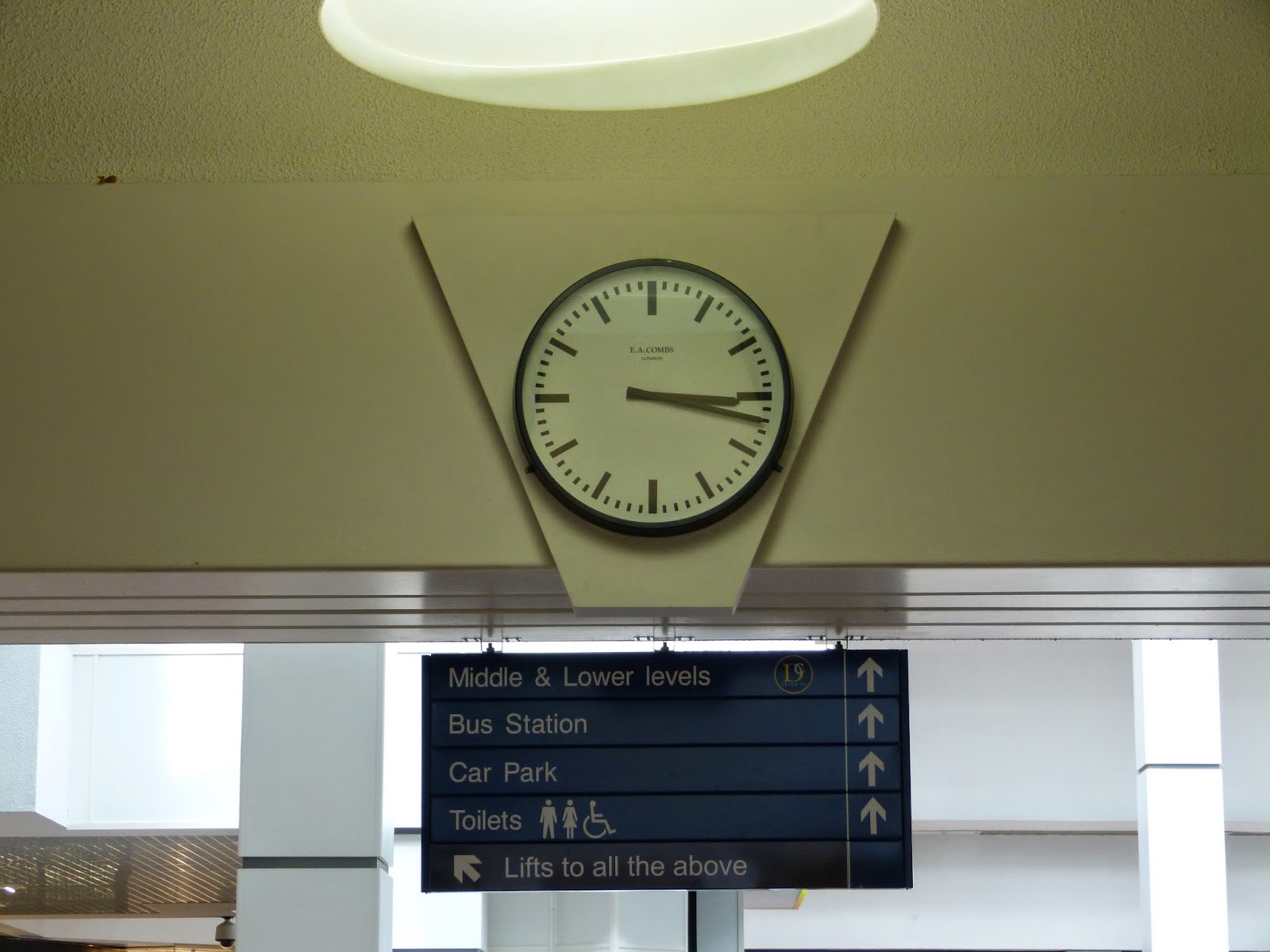
Let's go clock hunting in Shrewsbury, close to the England / Wales border. You get the feeling that this could be fertile ground for the type of clock that this blog features - it seems to be an analogue sort of town, as witnessed by the survival of semaphore signalling on the railways.
Talking of railways, I take the time honoured tradition of starting with the railway station (which is only logical when one arrives by train).
Shrewsbury station was built in 1848. It has an additional platform which is hidden away from the main station, and was used to transport prisoners to the adjacent prison up until the First World War.
The town is dominated by the huge clock tower on the Market Hall. I'm not quite sure why it needs to be this tall, but at least you have a chance of telling the time from virtually everywhere in the town centre.
The Market Hall was built in 1965, and has a fine range of stalls inside, including a splendid second-hand book shop. It also has this simple clock:
The Old Market Hall (whose name I assume resulted from what one today calls a rebranding exercise, but in the mid 1960's was just seen as a sensible thing to do - although it would be funny if the building was always called the Old Market Hall) is somewhat smaller and older (dating from 1596) than the Market Hall (which is not called the New Market Hall).
And having spouted all that nonsense above about rebranding, the plaque on the wall refers to The Market Hall.
A slightly more modern building of commerce is the Darwin Shopping Centre. The name doesn't reflect an evolutionary progression of the shopping mall to a consumers paradise (it is not too as these places go), but is a recognition that Charles Darwin was born in Shrewsbury in 1809.
Next stop is St Chad's. The original church collapsed in 1788, and the current building was opened on a new site in 1792. Parts of the old church still remain.
The Quarry is an area of parkland adjacent to the river. The Quarry Lodge was built in 1887 for the Parks Superintendent, and as such was the home of Percy Thrower from 1946 - 1974 (ah, memories of the Blue Peter garden...)
The Horticultural Society was (and maybe still is) a major benefactor to the populace. Everywhere you go in Shrewsbury there seems to be a sign saying that this part of the urban fabric had been donated by the Horticultural Society.
This is St Julians.
Shrewsbury Abbey was founded as a Benedictine monastery in 1083, with the Abbey building being the only significant survivor of the once extensive site.
The clock is unusual in that the traditional 'X' used on Roman numeral dials is replaced by an 'f''.
Our next religious building is St Mary's.
St Mary's has one of the tallest spires in England. In 1739 a showman by the name of Robert Cadman tried to take advantage of this by sliding down it in an attempt to build up enough speed to fly. His unfortunate end is marked by a plaque on the church wall.
The splendid library building is the former home of Shrewsbury School.
Shrewsbury retains some wonderful street names reflecting the trades (and sometimes dubious activities - Grope Lane for example) that used to take place there. This is Butcher Row.
The County Goldsmith's shop has this Rolex sign which I am guessing was once a clock.
Now to an idyllic seem of the river and the greenery on its banks. The building in the background is Shrewsbury School.
Out to the south-east of the town in the modern industrial parks is this now-closed plumbers merchants in Brassey Road.
This next example probably doesn't really qualify as a public clock, but hey it clearly is a clock and it is the only new one I spotted after a long hot walk to capture the plumbers merchants one above, so I have included it just to make my excursion worth while.
This is a clock in the window of Mansers auctioneers. I assume that it is for sale, but it might be a permanent fixture.
More retail therapy now, with interlinking shopping centres. First is Pride Hill looking all nice and airy.
Followed by the Riverside Mall which is mainly a series of empty shops.
And a quick look at the bus station...
I have saved my favourite clock in Shrewsbury to last. this is Morris Lubricants on Castle Foregate.
The whole building, but especially the clock tower, exudes a pride in the company's work. Morris Lubricants have been manufacturing in Shrewsbury since 1869.