Let's start at the end - Wallsend to be precise, which marks the end of, well, the wall - Hadrian's Wall.

The building is Wallsend Town Hall, a Grade II listed building completed in 1908, and still used by the local authority. Which is more than can be said for the stylish modern library building just around the corner, now lying scandalously empty.

The clock is by Potts, with drum made by Jones & Willis Ltd or Hornsey, and was set going on 16 September 1908. [As so often, thanks to the book "Potts of Leeds" by Michael S. Potts].


A bit further downriver is the Maritime Chambers building of 1806/07 in North Shields.


Details of the building can be found on this plaque:

Down by the river itself we find the Fish Quay. The area has been in the business of landing fish since 1225, and was once the biggest kipper producer in the UK. Now it is the home to two clocks, the first being this cuboid on Vita House:


And from here you can see the huge clock on the Knott Memorial Flats, covered in my posting of 9 July 2013.

The second one is on the Dock Master's House.


And looking up the cliff edge running up from the river, is this tall white building with a clock in its upper window. Must rather obscure the view from inside.


Time now to mix song titles to give Fog on the Mersey and Ferry Across the Tyne. For the easiest way to reach our next destination is to take the Shields Ferry across the Tyne from North Shields to South Shields. The ferry can be seen in the photo below - the little boat to the left, rather than the somewhat larger North Sea ferry.

And if you take the ferry, please note that as you look back through the drizzly gloom to the north bank, the circular object on this derelict pub is actually a Newcastle Breweries sign, and not a clock as I found to my cost retracing my steps in heavy rain and negotiating a demolition and regeneration site (with lots of dead-end roads) a few days later.

Back to real clocks. This next building is South Tyneside Law Courts.
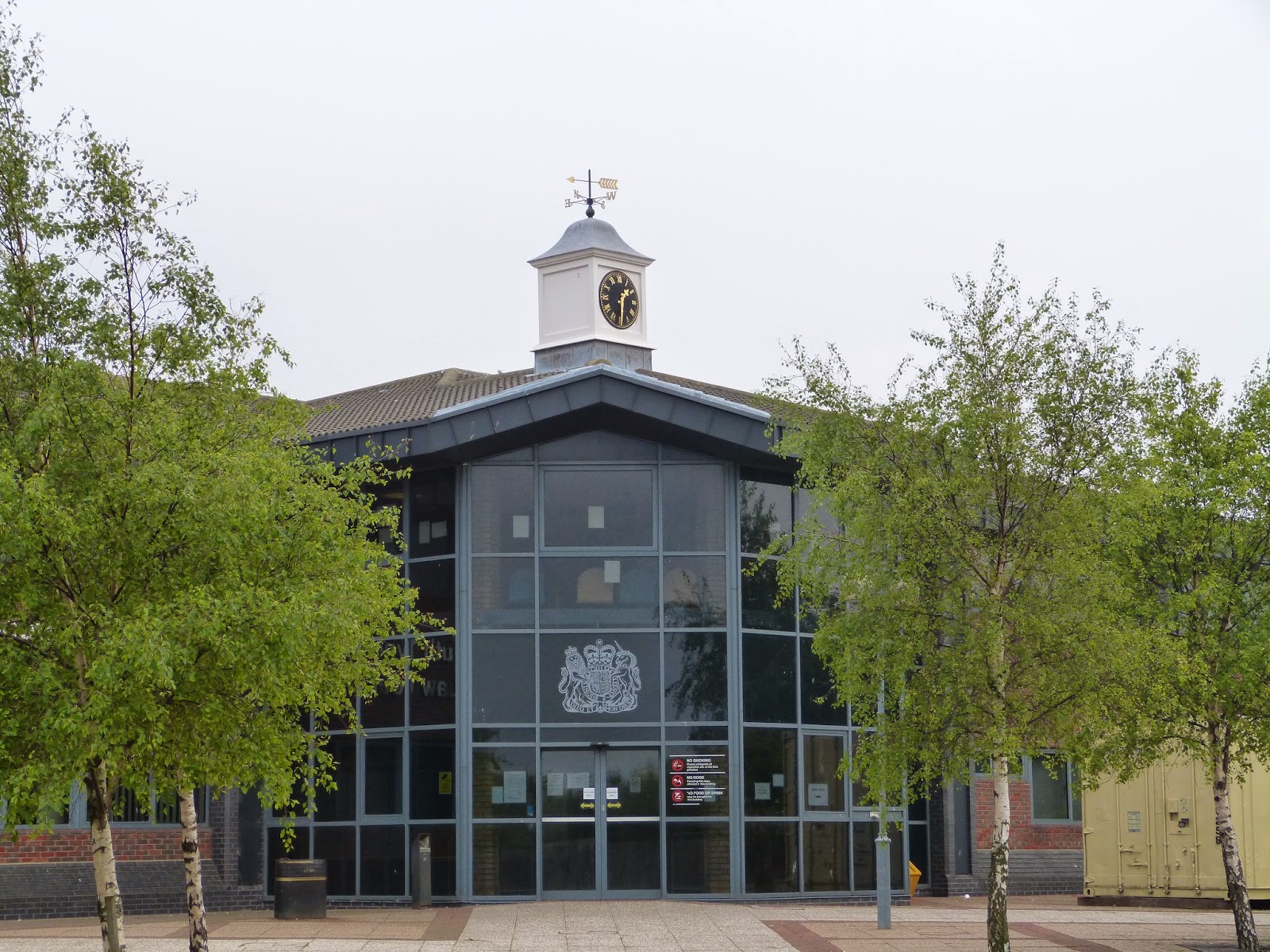


Just behind the Law Courts is this unidentified building, which I assume is some form of retail outlet.


At the junction of Commercial Road and West Holborn is this huge building. I believe this used to be Redheads Shipyard, which means that the clock is a 1945 example from Potts.


Let's get well away from the river, and take a trip to the airport. Newcastle airport was originally opened on 26 July 1935 and, although certainly nowhere the largest in the country, handles 4 - 5 million passengers per year.
The international arrivals hall is graced by this compass inspired clock.


At the other end of the same building is the domestic arrivals hall. Here there is a more subtle, but in my view more effective, design.


The clock was unveiled to mark the Queen's Diamond Jubilee. It is made out of brushed steel by Smith of Derby.

Alighting from the metro at Kingston Park on the way back from the airport, you have the chance to visit a delightful out-of-town retail park (aka a sea of car parks and pedestrian un-friendly roads surrounding very large sheds with chain stores in them).

The only slight (and it is very slight indeed) redeeming feature is the clock on top of the Poundland store (probably the only time that the phrases 'redeeming feature' and 'Poundland store' have ever been used in the same sentence).
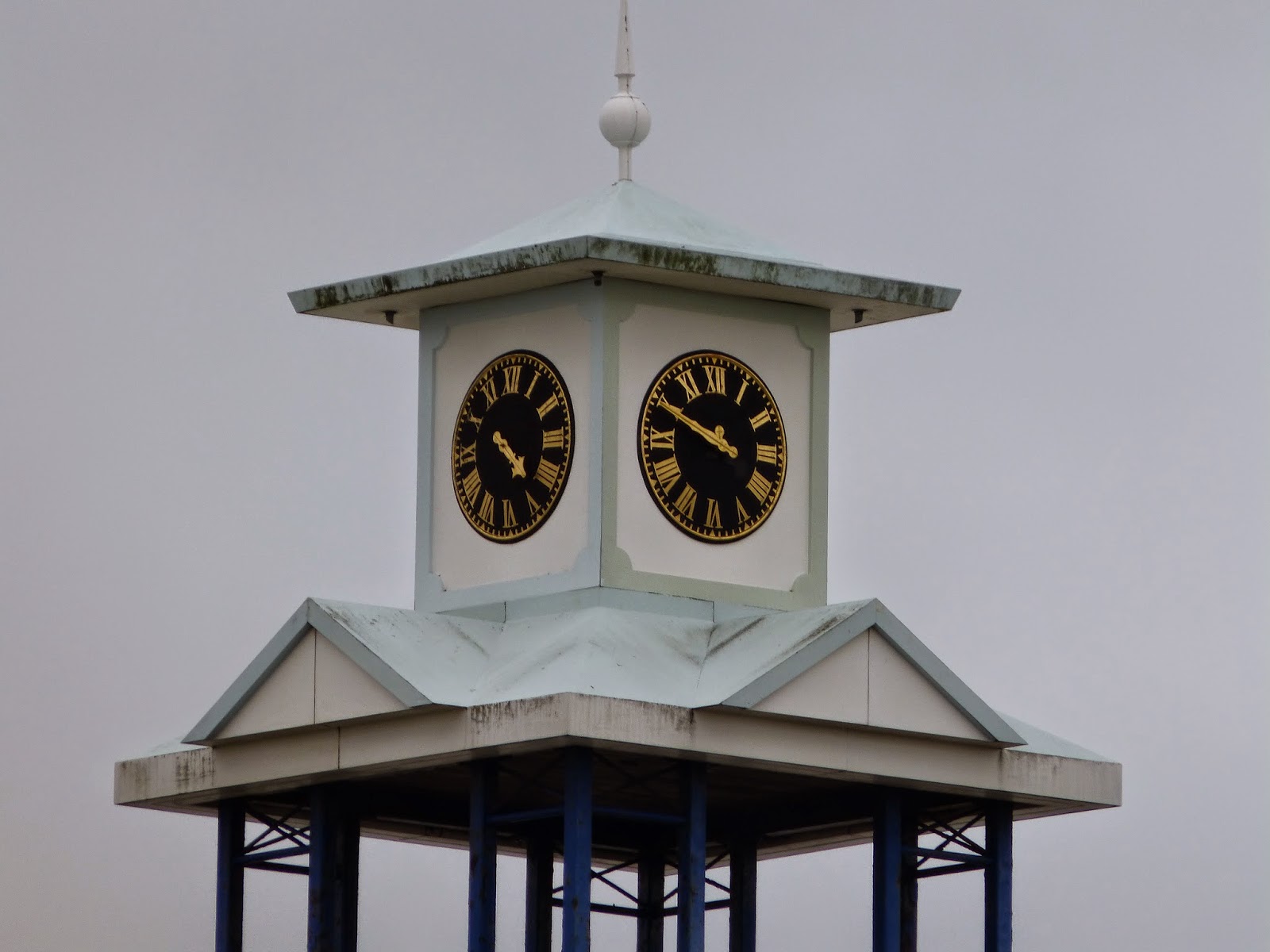
And what on earth is this all about? A clock tower (bog-standard off-the-shelf modern design) nestled on some form of steel framework tower, itself sitting on a tower. Some form of metaphor for the modern shopping reality of piling unnecessary things upon even more unnecessary things to create something that is of no real use and certainly is not a thing of beauty, but exists because it can and someone was bereft of enough intelligence to fund it? To me it reminds me of the upper stages of a space rocket. Poundland we have a problem.

Closer inspection of the clock faces also reveals that this edifice also lacks in functionality.
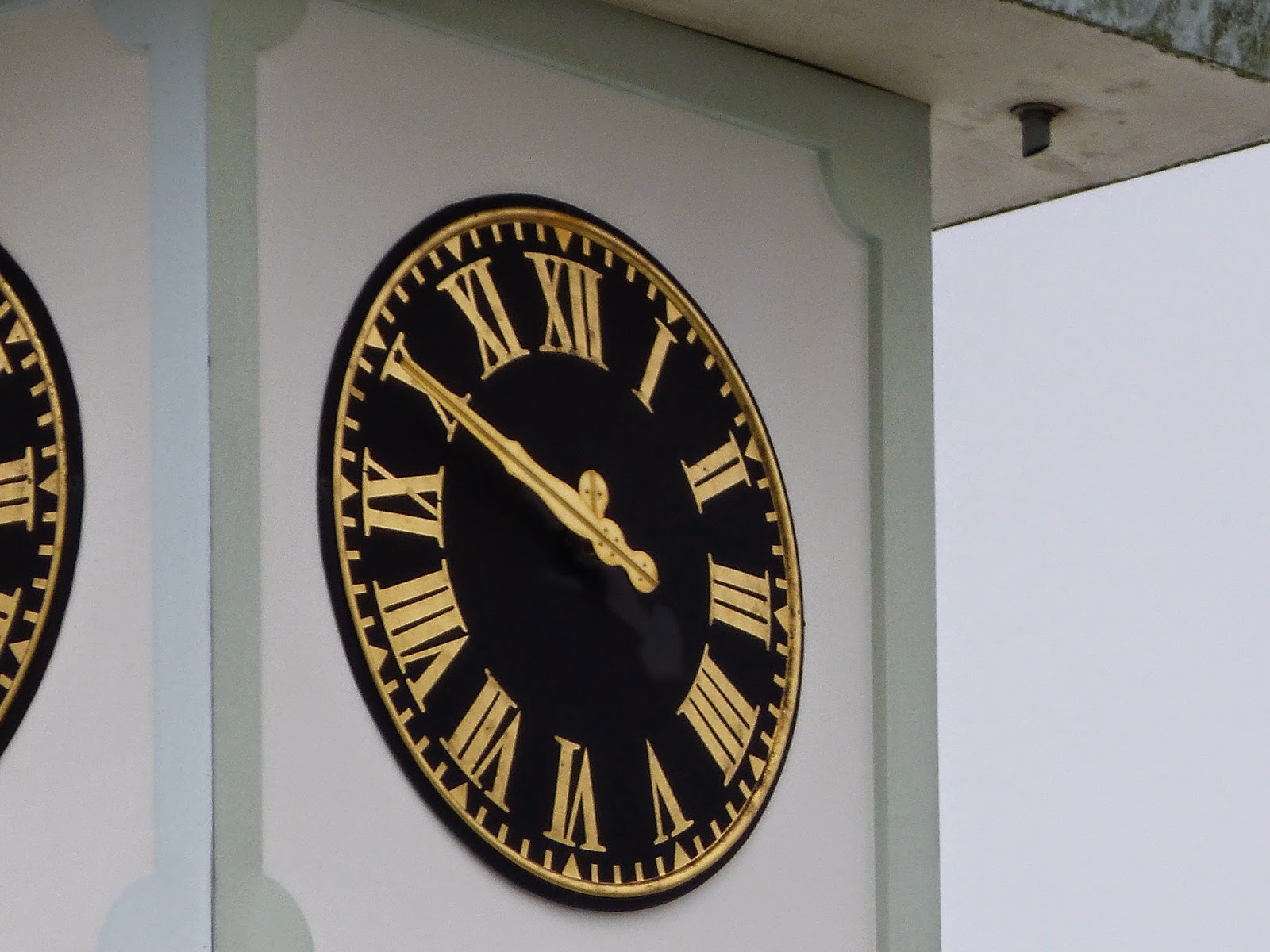
To be fair to Poundland, you wouldn't really expect architecture on one of its stores. As for some of the other so-called more upmarket stores that surround it, well you didn't even try did you?
The Discovery Museum is housed in the old Co-operative Wholesale Society warehouses and offices of 1897 - 99. Don't do what I did and turn up only 30 minutes before closing time as there is a lot worth seeing. And apart form all the exhibits, there is also the Great Hall on the fourth floor.


