Around the Ring Road - sounds like it could be a novel. But no, it is what it says it is, a look at clocks that can be found around Leicester's ring road (the A594). Or at least fairly close to the ring road. To avoid confusion, I am referring to the inner ring road (although it is also called the central ring road) rather than the outer one. The sort of road that transport and town planners loved to build in the 1960s and 1970s to bring despondency, decay and despair to city centres. The number A594 is used only for this 6 km stretch of road (although there is another 9 km A594 in Cumbria). If you are really interested in it there is an 18 minute video of driving around the road that can be seen at
http://www.storyofleicester.info/cityheritage/builtheritagecontinued/innerringroad/.
At the end of Part 1 we were at the Guildhall. A short walk westwards along the High Street brings us to the wall of traffic. Finding a safe place to cross allows us to reach St Nicholas Circle and the church of, well, St Nicholas. This is the sort of building that always ends up next to ring roads - even in the 1960s it wouldn't be easy to get permission to demolish it, so the road is built to accommodate it. So it is left cut off from its surroundings, benefitting from all the noise and pollution.
The present clock was installed in 1929.
The helpful sign outside has some details of the building's history:
And I have allowed another sundial to creep into this blog.
If you look across back towards the other side of the ring road you will see this building:
Which if you look carefully enough, you will see has this clock (don't get distracted by the one on the spire to the right - that is the cathedral which we have already discussed in Part 1):
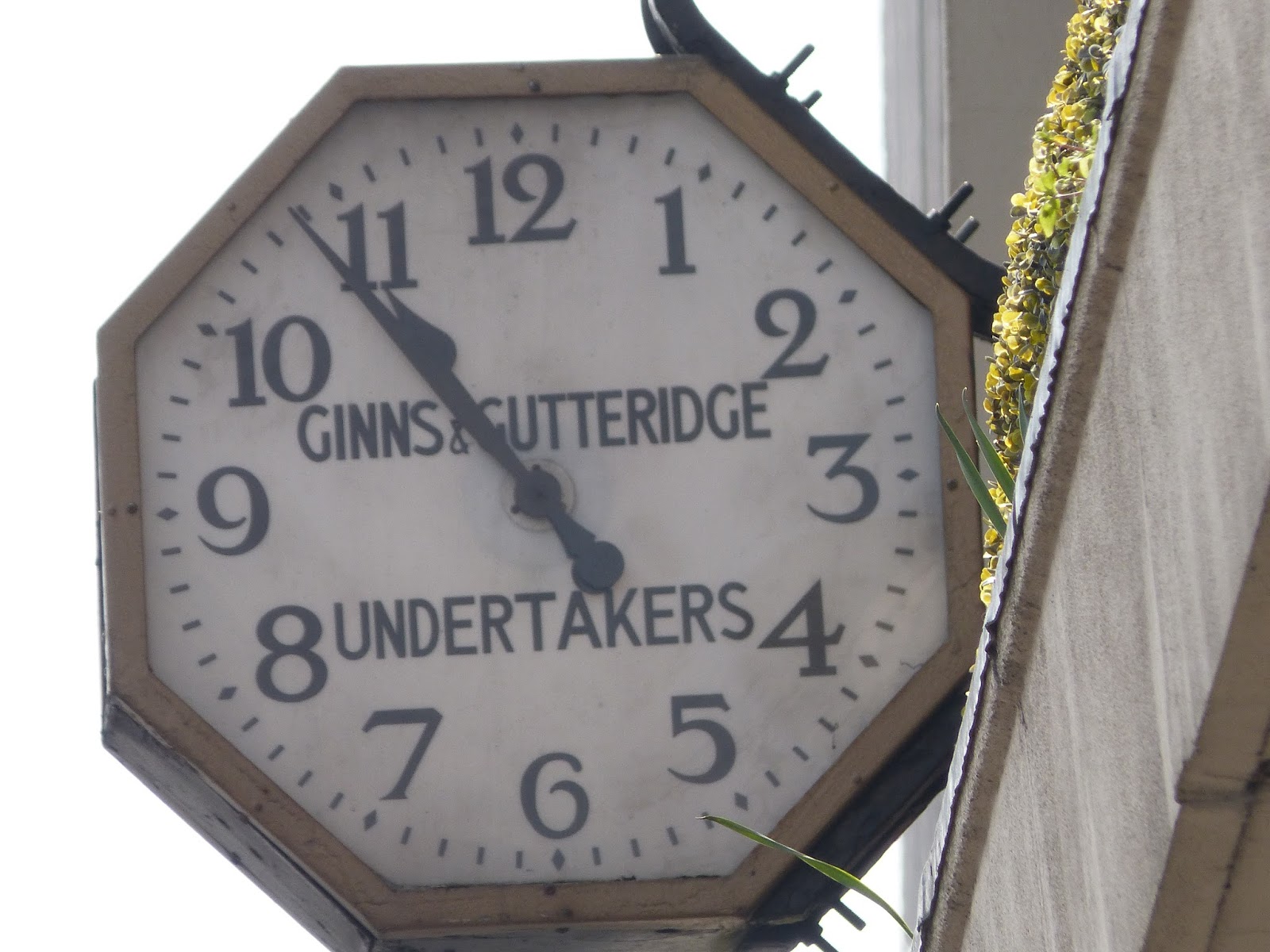
But let's stay on this outer side of the ring road, hereabouts called Vaughan Way. At no. 51 is St Nicholas House, home of what is now Dignity plc, a large funeral directors company.
Dignity was formed by buying up a number of local firms, in this case Ginns & Gutteridge (founded in 1855) as evidence by the nice octagonal clock.
It is a shame it is not showing the right time, on either face.
Heading clockwise around the ring road, take a left into Highcross Street. Ahead you will see this familiar-looking clock:
This is All Saints, and the clock on which the Guildhall one (see Part 1) is based. According to the leaflet "Discover Leicesters City Churches" (shouldn't there be an apostrophe in there?) it is "one of the oldest working parish clocks in the country", dating from c1610.
Information from the booklet "An Introduction to he History of Timekeeping - The Leicester Time-Trail" by Allan Mills notes that this automaton clock (i.e. it has mechanical figures) was restored in 1899 and again in 1926.
Back on the ring road, our next clock can be found at St Margaret's church on St Margaret's Way.
Sticking with "Discover Leicesters City Churches", "the earliest place of Christian worship in Leicester (653) was on this site". The current church was begun in 1110, with the tower being rebuilt in 1444.
Slightly less grand and ornate is St Margaret's bus station on the inner side of the ring road. the main bus station itself does not have a clock, but this example can be found by the National Express stops on Gravel Street.
We are on the eastern side of the ring road now, where it is known as St Matthew's Way.
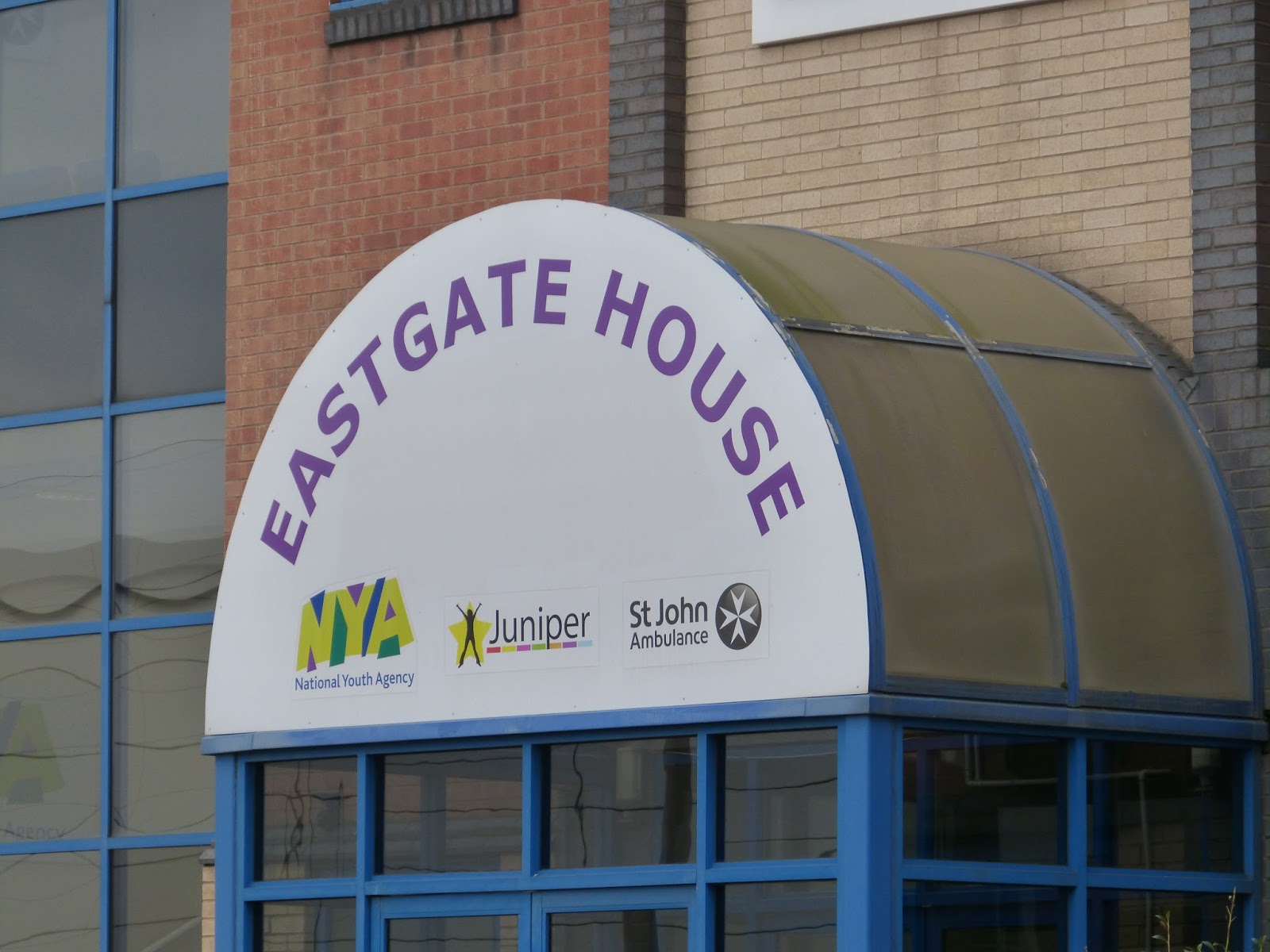
Eastgate House is a new-build on Humberstone Road.
Always nice to see a new building with a clock, especially one that is in keeping with the architecture rather than some pastiche of a Victorian or older clock. Other than that, not a lot to say about this building (mainly because I couldn't find any information).
A bit further along Humberstone Road is the much older building of St George's Mill.
Clearly an old industrial building, now converted into flats.
We are actually heading back to the city centre, and towards the clock tower. But before we get there, lets divert down Charles Street where we can meet Halford House.
Hello Halford House we say.
This was built in 1955-59 as the headquarters of the Leicester Temperance Building Society, later part of Alliance & Leicester.
The clock, unfortunately not working, is surrounded by a lovely sculpture of the four winds, by locally based artist Albert Pountney (1915 - 1982).
Ok, now it is down Halford Street, past the Curve Theatre, and on to St George's.
It was not easy to get a good shot of the clock in the dying light, with large trees obscuring the view and other nearby building reducing the angles.
Anyway, I think it must be trim time!
This is a barber's shop on Northampton Street. For some reason the clock is set at a jaunty angle - but as it is not working this is rather irrelevant.
We are nearly there. just two more stops on our ring road extravaganza. I couldn't of course miss out the railway station.
There has been a station on this site since 1840, but the current building dates from 1894.
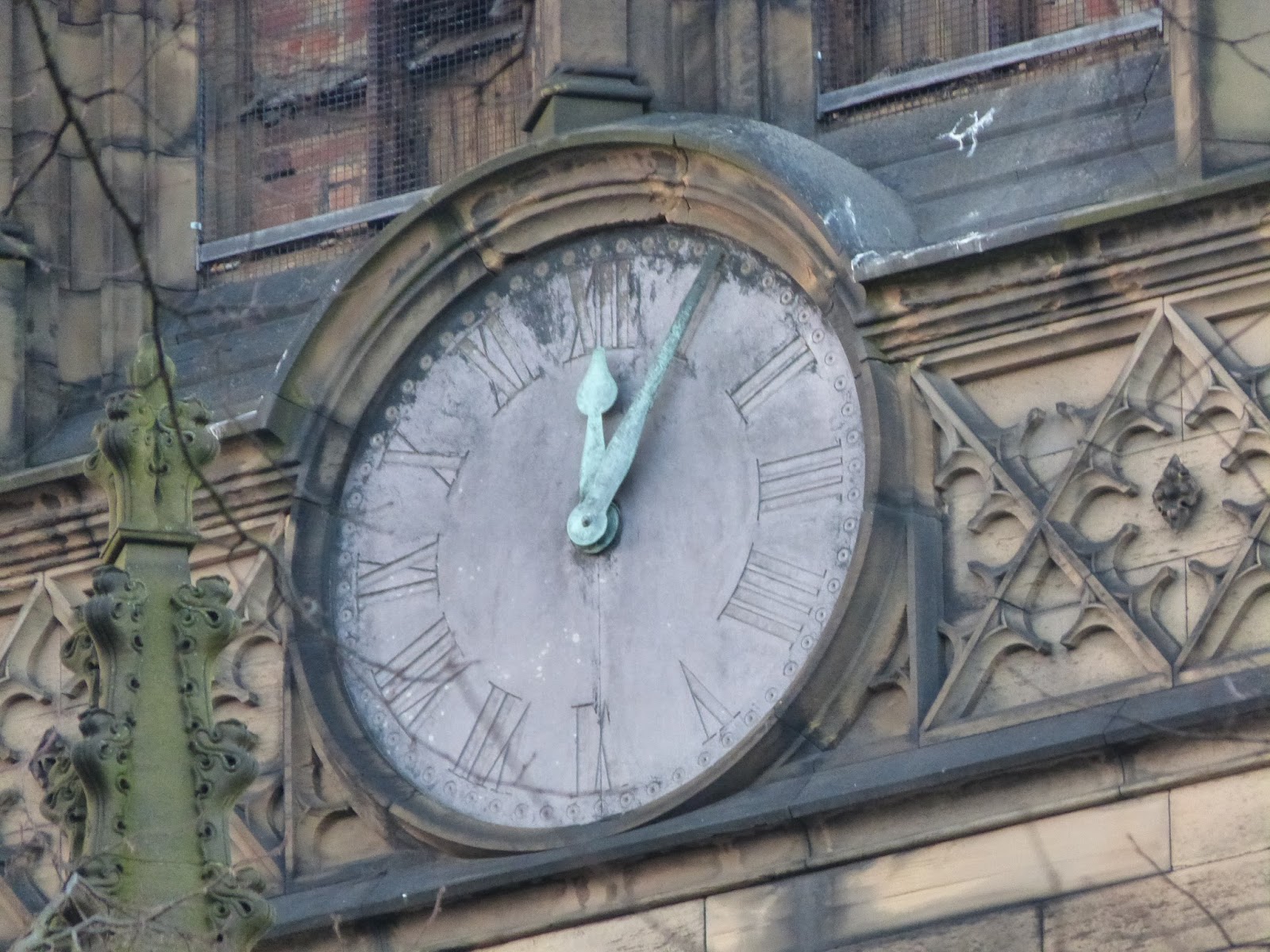
And finally, Holy Trinity church on Regent Road. This was originally built in 1838, but completed re-modelled in 1872.
Time to put our feet up for a bit, before embarking on Part 3.