Showing posts with label pierdom. Show all posts

Saturday, 25 February 2017

Eastbourne (Part 2)

It must be time to visit the pier. I just love these structures, which are on one level totally ludicrous, but on all other levels are completely wonderful.


The land end of the pier has an entrance structure with that unfortunately all too common feature - a clock with no hands.


Luckily the main pier structure retains a fully-functioning clock.


According to the excellent book "Pierdom" by Simon Roberts, the pier was opened in 1870, although not completed until two years later. It is 305m  long.


The photograph in Pierdom shows a rather monochrome structure. However, since then the pier has been bought by Mr Gulzar, a local businessman. Much to the dismay of some residents, this resulted in the domes being painted gold and a new blue colour scheme for much of the other ironwork. Personally I think this is how a pier should look - a delicate balance between sophistication and that particular brand of seaside tackiness. and most importantly of all Mr Gulzar is investing money in maintaining the pier.


Looking back from the end of the pier, you can spot this next building.


With feet back on dry ground, we discover that this is the Leaf Hall Community Arts Centre on Seaside.


My assumption was that this was a church that had converted into a new use. How wrong could I be? The hall's website (www.leafhall.co.uk) reveals that this building was opened on 9 June 1864 "to promote the social, moral and spiritual welfare of the working classes of Eastbourne" i.e was built as a community facility.


The clock tower was restored in 2000.


This next little beauty is All Souls church on Susans Road.


Described on Wikipedia as "a polychromatic Byzantine building with a prominent campanile", this Grade II* listed building was designed by Alfred Strong and completed in 1882.


Not so stylish is this more modern building in Langney Road.


Back to the churches. This is Holy Trinity, another Grade II* listed building.


Holy Trinity was completed in 1839, with later additions in 1855 - 1861.


More modern buildings. This is the tourist information office on Cornfield Road.


We are heading back towards the station now. And indeed back on Terminus Road. the pedestrian sections has this rather unusual clock.

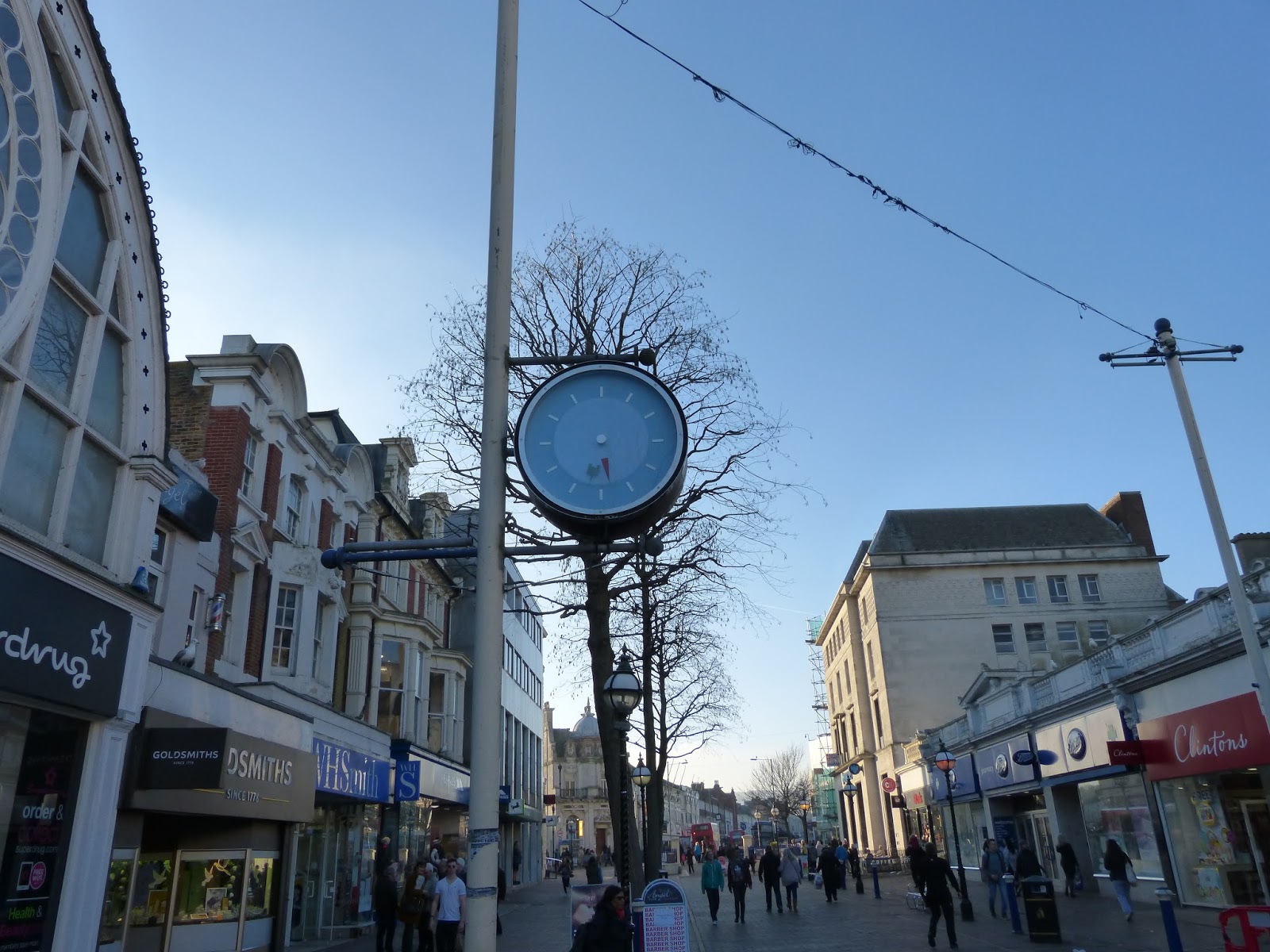


A clock with invisible hands.


A quick trip into the Arndale Centre (1981) yields a rather modest clock.


Back out into Terminus Road for some fresh air and a more substantial clock.


This clock now resides above Buffet Time, but the original legend reads "Bruford's Jewellers".


Sunday, 9 November 2014

Deal

Deal is just a little bit further around the coast from our last point of call, Dover. What should have been a short hop on the train turned out to be a longer rail-replacement bus service, although more accurately a coach service. The annoyance of this was, however, outweighed by the fact that it revealed four clocks on the run into Deal which would not have been spotted from the train.

The first of these clocks is at the Cavalry Barracks in Dover Road. Now a residential development (as is the fate of every interesting building in the country and probably the world), this was once part of the substantial military presence in the town.


And as it is a residential conversion it is of course gated. Which unfortunately means that the view down the drive through the bars of the gate result in the clock being obscured by the flagpole.


Continuing in to the centre of Deal (although the place seems to be called Walmer rather than Deal), the next interesting location is the lifeboat station, built in 1871.


Continuing the military theme, we next come to North Barracks.


And then on to East Barracks, which has now acquired the name Admiralty Mews (Private Road) as it has also metamorphosed into another residential development.


No respectable Victorian seaside town is complete without its pier. Deal pier is rather unusual in that it has concrete supports rather than the more common timber or cast iron.


There has been a pier in Deal since 1838, but this version dates from 1957, hence the more modern construction method. Total length of the pier is 313 m (with thanks to the book "Pierdom" by Simon Roberts - great pictures of all the piers in the UK).


A quick look now at the railway station, opened in 1847, with its utilitarian clock in the booking hall.


Retail therapy now in the great little shopping streets of Deal ("a good deal to be found and good deals to be had" as the saying might go if the Chamber of Commerce wanted to have a cheesy slogan).

This is Hoads, a shoe shop....


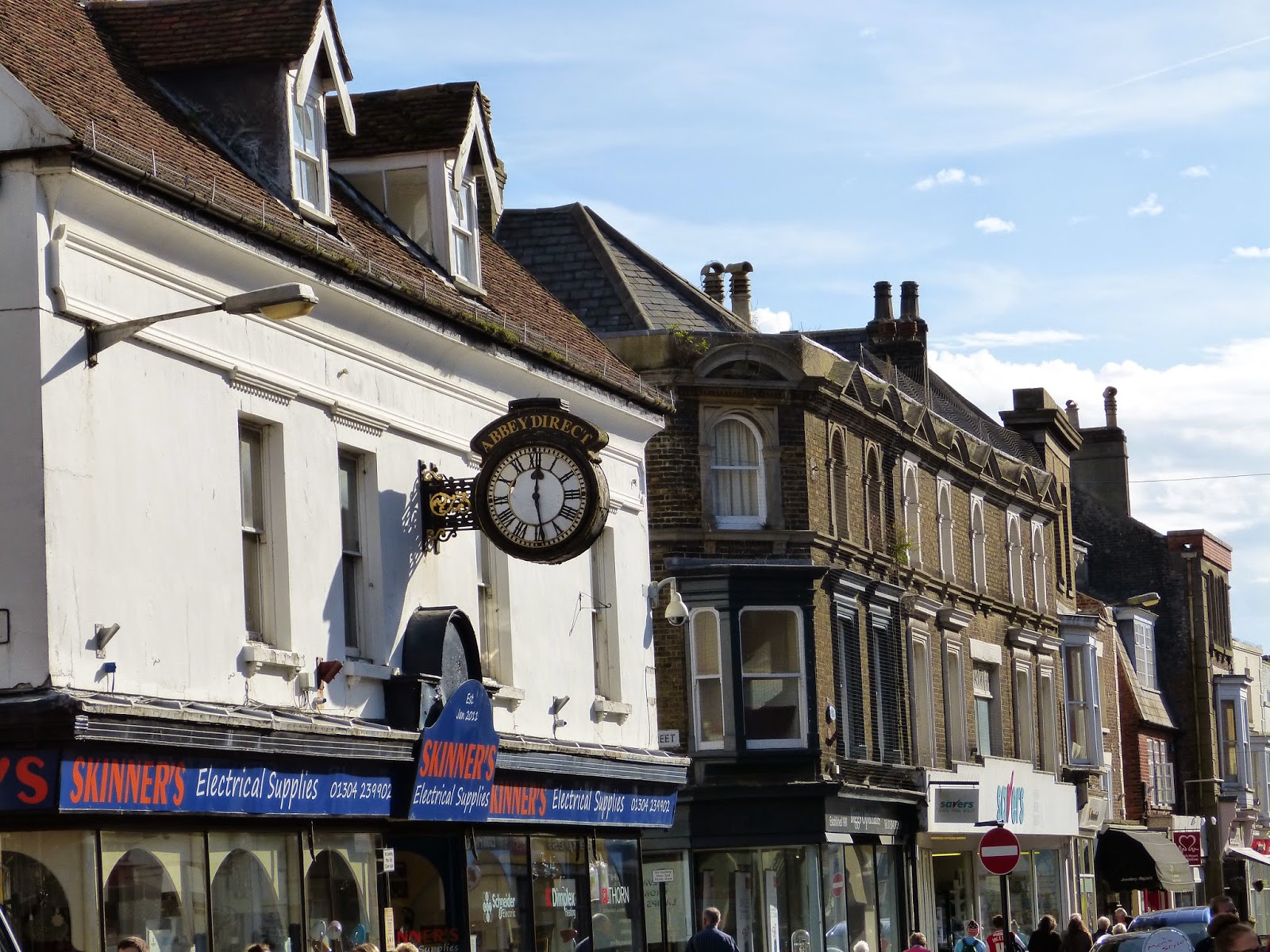
...and this clock can be found on Skinners, an electrical supplier.

.

Clearly this building on the High Street has seen a number of occupants over the years, as witnessed by the different names on each side of the clock.


Still on the High Street, this is St George's church of 1710.


And finally not a proper clock at all (although there is a small one in the downstairs window) but the much rarer sight of a timeball.


The building houses a museum, but unfortunately it is closed at this time of the year.