Showing posts with label station. Show all posts

Saturday, 2 May 2026

Llandudno

 Off the North Wales main line at Llandudno Junction and up the branch to Llandudno.

As so very often, our first clock sighting is at the railway station.


This is the sort of clock I like. It is situated where it is clear to see, is large enough to seen from a distance, and has a simple face - all of which makes the task of telling the time very easy. It also doesn't take much of a detective to know from the photos that this clock is at Lllandudno station.


The station was first opened in October 158, but the current buidling dates from 1892. The branch to Llandudno was originally built to serve a proposed harbour which would have served the route the Ireland, but the development of Holyhead harbour to the west put paid to this proposal. The railway now serves a nice seaside resort town.

Incidentally, the clock looked even more impressive later in the day when the sun was shining.


The town has many nice shops, some with covered pavements to provide protection from the elements, and it also has the indoor Victoria Centre on Mostyn Street. It has approximately 100,000 suare feet of shopping and claims to be "Llandudno's principal multi-storey shoppers car park (366 spaces)", which is probably true but terribly impressive. However, it is redeemed by having both an internal and external clock.

The internal clcok mirrors the one at the station in its simple effectives, although this time with an elegant blue and gold face.


The external clock sits under a broken pediment with a bell.


The clock face is a bit more ornate, but sadly it does not show the correct time.


Also on Mostyn Street is the local branch of the Halifax building society (which reminds me that I need to write up my visit to Halifax - the town - which I made in January).


And again it is a case of nice clock, shame about the time.


The Friends of Mostyn Facebook page form July 2023 was asking for as many pictures of possible of this clock over the years. The page also says that this was a gas powered illuminated clock installed in 1876.


The Home Front Museum's Facebook page (30 Decmber 2025) claims that the clock was installed to distinguish shop belonging to Richard Owen from another premises trading under the same name. The page also says that the clock was manufactured by Manchester clockmaker Samuel Burman.


Just around the corner is the floral clock.


The Friends of Mostyn Street Facebook page (which I am definitely beginning to like) of 13 July 2025 says that they are responsible for the current planting of the clock in the form of the White Rabbit's Pocket watch. This is also repaetd on a small sign.


The planting is obviously not so impressive at this time of year (late March), but it is much more impressive when it is in its floral prime.


Floral clocks were once quite common, especially in large parks and seaside resorts. The first example in the UK was installed in West Princes Street Gardens in Edinburgh in 1903, with the world's first example in the Trocadero Gardens in Paris in 1892. There is a lot more information, and examples of other UK examples at gardensheritageandplanning.com. And perhaps this could be the inspiration for a subset of this blog if I can get a list of all the UK floral clocks which still exist.


I do love a bit of quirky transport, and the Great Orme Tramway fits that description nicely. The Great Orme is a headland high up to the north of the town, and the tramway (built in 1902) is surely the best way of reaching it.  More importantly for this blog, the base station (Victoria) has a clock.


The tramway's website claims that this is the only funicular tramway in Britain that runs on public roads. The trams are open sided, which wasn't very good on the very windy March day that I visited, but it is well worth the ride.


Our final Llandudno clock isn't actually there. I had seen pictures of the Millennium Clock which was situated in the middle of a roundabout on Mostyn Street, but walking up and down several times I couldn't find what should have been an obvious one to spot. A bit of detective work looking at the buildings in the background of photographs led me to find the right location.


A careful look at the vegetation revealed the base of the clock. So whilst the nearby clock on the Halifax branch has lasted for 150 years, the Millennieum clock proabably didn't make it to 25 years.


And so down the line to Colwyn Bay...


Sunday, 7 April 2019

Bath

To Bath, in glorious sunshine, with not even the hint of a shower (groan)

As is usual, we start at the railway station. The railway came relatively early to Bath, as part of the legendary Isambard Kingdom Brunel's Great Western Railway. The station dates from 1840.

The clock is simplicity itself, with a plain blue face and only the numerals as marks. Being bath, these are of course Roman numerals.


There is also a modern clock by one of the gatelines within the station:


Close by is the church of St John the Evangelist, which was built in exactly two years between October 1861 and October 1863.


The design is by Charles Hansom, architect of 50 Catholic churches, although its grandeur is somewhat muted by the large surface car park in front of it.


Its proximity to the railway station has some significance. The church's website (www.stjohnsrcbath.org.uk) notes that the clock installed in 1868 was a reliable timepiece, and that "it was reputed to have been used to dispatch the trains in the days before the station was enlarged". Just out of interest, my GWR train from Bath later in the day was 14 minutes late. (Although, having said that, the clock was an hour out).


I was visiting Bath to see the George Shaw exhibition at the Holburne Museum. My route to the museum took me past two other clocks - firstly this one at Bath Cricket Club on North Parade Road:


And secondly at the church of St Mary the Virgin on Darlington Street, dating from 1820.


Next up, another church. This time it is St Swithins on London Road.


This has been a religious site since the 10th century, but as the plaque says, the current building was rebuilt in 1777, with the tower added later in 1790. It is also the church where Jane Austen's  parents were married, which excites some people.


I was beginning to get the feel that the majority of clocks would be on churches. Bath is a sort of preserved in aspic kind of place - I know I shouldn't really say this, but to me this makes the place somewhat boring as there is less variety in architectural styles, and certainly one dominating colour of building material. Planning restrictions must be draconian. I was therefore resigning myself to reporting on the railway station and a few churches. But lo, there was The Old Post Office.


From a distance in the strong light it looked like there was only a dilapidated dial remaining, but closer inspection reveals that the hands are still there.


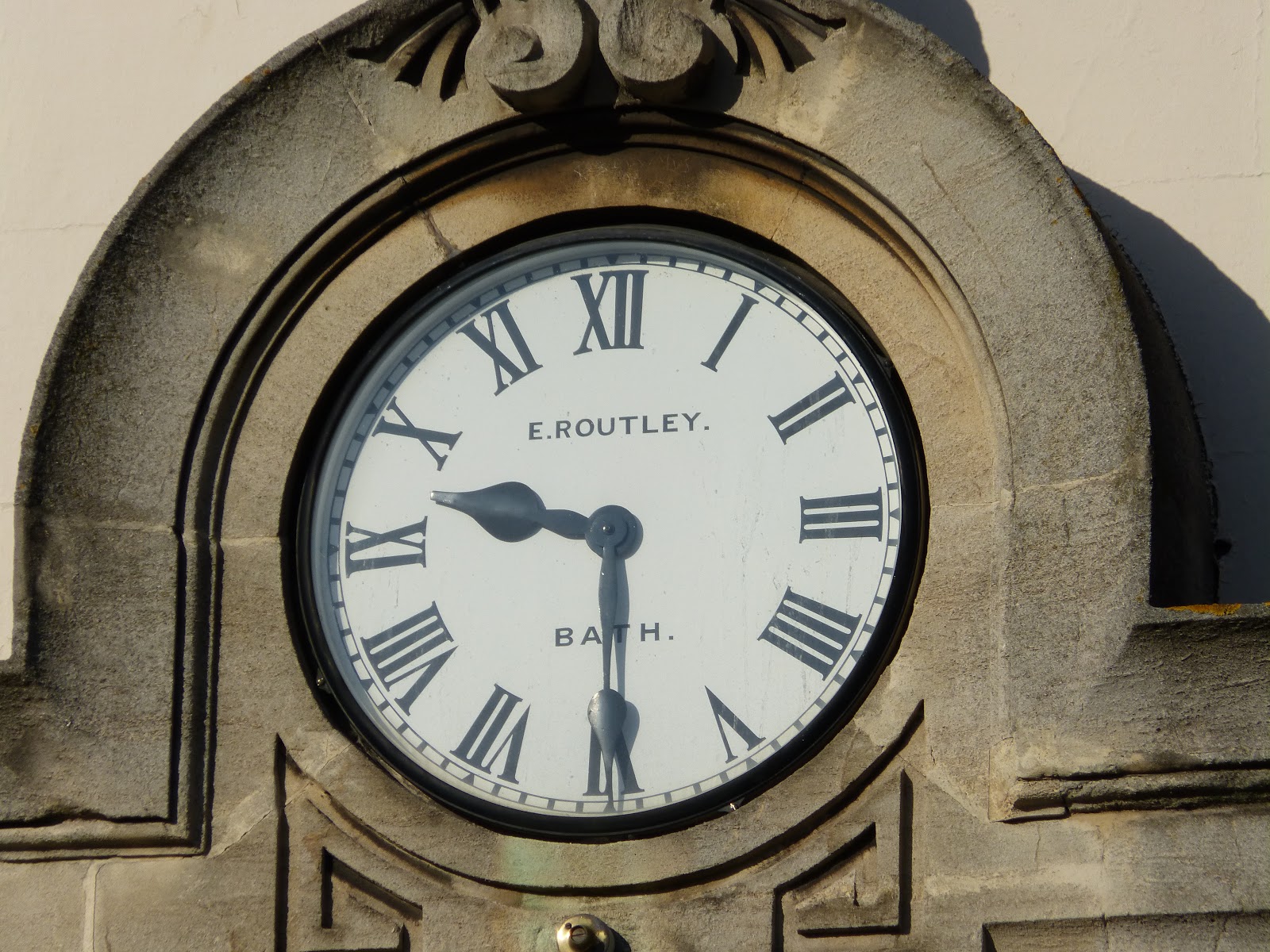
The Old Post Office, whose ground floor contains a Revolution bar, starts us off on a series of commercial premises with clocks. The next example is Flan O'Briens on the corner of Saw Close and Westgate Street.


The clock bears the name E Routley of Bath. I believe this is Edwin Routley, but I have no further information on this clockmaker.


A little further up Saw Close is Giggling Squid, a chain that I hadn't previously heard of.


This is a nice classic clock - gold Roman numerals on a blue face, minute marks and gold hands. Simple, elegant and effective. Just a shame this was mid afternoon, and not ten past ten.


Another commercial premises - Radley's on Old Bond Street. And another clock that is not showing the right time.


Back to churches, and the big one - the Abbey. Founded in the 7th century, the current building dates from 1616 (ish - as usual, all sorts of rebuildings and other goings on), with a major restoration by Sir George Gilbert Scott in the 1860s.


The clock dates from 1888, and is by Potts of Leeds. It cost £240 at the time.


Just time before my train to put across the River Avon to St Thomas and St Matt's on Widcombe Hill.


And finally, I returned to Bath in the evening for a book talk / signing (Lotharingia by Simon Winder, since you ask). Night time with just my phone, I have poorly captured this clock on Argyll Street.


And this is the Neptune restaurant in Beehive Yard - if you look hard you can just se the clock.


Ant that's Bath.