Monday, 13 July 2015

Southampton (Part 2)

After touring around the edges, it is now time to strike down the main spine of the city, north to south.

The newish construction that is Moore Blatch Solicitors sits on the junction of Bellevue Road with London Road. In terms of clock hunting, this was a classic case of making sure that you look everywhere. Walking north up London Road on the same side as the building, I was totally oblivious to the clock. It goes to show that it pays to walk both ways along, particular urban, roads.


Just to the south, where London Road meets Cumberland Place and is just about to turn into Above Bar Street (now marketed as the QE2 Mile - rather confusingly as everywhere else the city bangs on about the Titanic) is another example of a modern building with an old-fashioned style clock. This time it is the offices of Paris Smith, a big regional law firm. Is it now compulsory for legal firms to have clocks - something to do with charging by the hour perhaps?


Lets move on. The Civic Centre is the cultural heart of the city, although slightly tarnished now by part of the complex now being the O2 Guildhall, the modern extension that houses SeaCity (which bizarrely was advertising dinosaur exhibitions, dinosaurs not being renowned for their ship building expertise or sailing adventures), and I am sure that the art collection is not as big as it used to be. Although that last point may just be the Wagon Wheel phenomenon.


Anyway, Civic Centre, big clock tower. In many ways a rather silly construction, but a glorious silly construction. I mistimed my visit as in the next few weeks there are some guided tours inside the tower.


Back to the QE2 Mile, which is one of the main shopping streets - or rather the residue that hasn't been hoovered up into the West Quays shopping centre or the awful retail sheds that lie to the west of it.

This is a standard Rolex clock on the premises of Parkhouse Jewellers.


Nearby is a Rotary International clock (celebrating 100 years) on top of an advertising column.


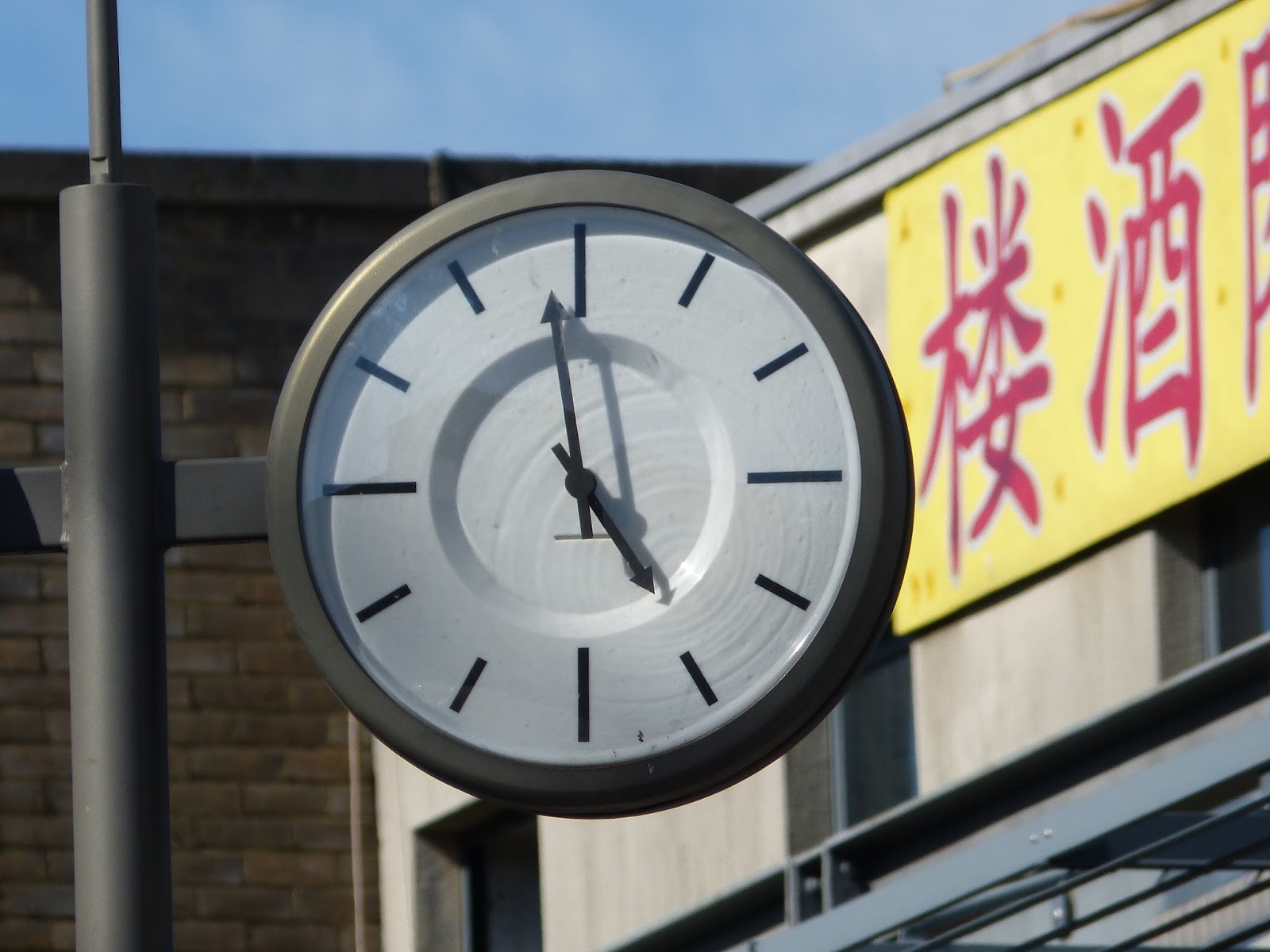

I love this next clock on the junction with Bargate Street. The simplicity and the materials, both of the clock face and the wall it is on, just seem to be in harmony.


Just a shame it doesn't give the right time!


The Bargate shopping centre is now closed, perhaps sucked dry by the shiny new West Quays centre. Was this once a clock above its now locked doors?


And finally, something of older Southampton. This is Holy Rood church, or rather the remains of it.


The building, originally built in 1320, was severely damaged by bombing on 30 November 1940.


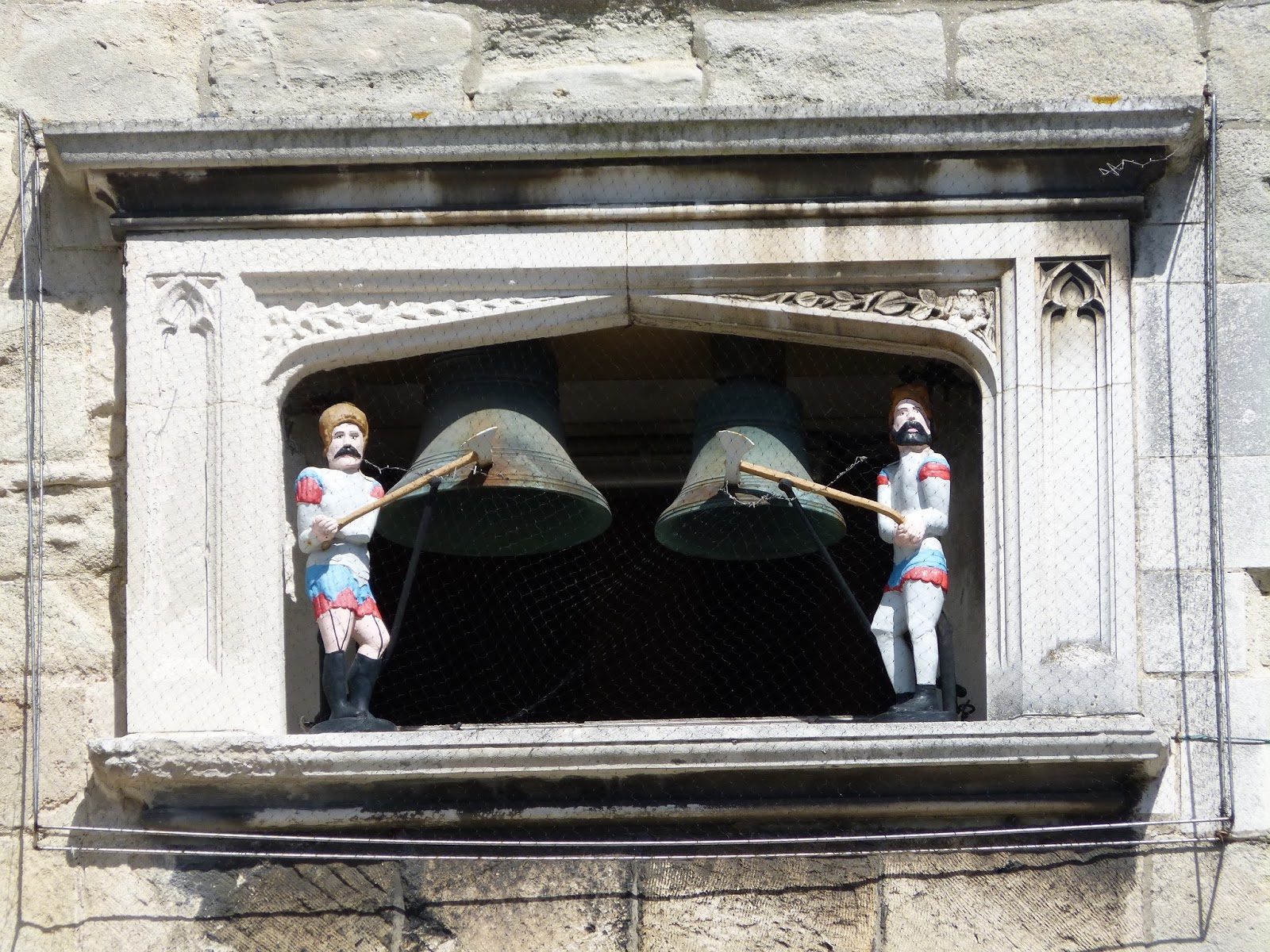
And so with the banging of the bells, we say goodbye to Southampton.


Saturday, 11 July 2015

St Pancras (Art Clock)

The nature of this blog would suggest that I love public clocks. I also love the work of the artist Cornelia Parker (I think I made reference to her exhibition in the Whitworth Gallery in one of the recent Manchester postings). And I also love the trainshed at St Pancras. So when I heard that the latest in the series (Terrace Wires) of artworks suspended in front of the Dent clock was in fact a clock by Cornelia Parker I was in heaven.

And seeing the work did not disappoint. Happy days!


The work is called One More Time, and involves a negative image of the clock face placed 16 metres in front of it. As you move around the station there is astronomical sensation as the art clock moves like the moon in front of the real one.


The beauty of it is that the artwork is also a working clock, with the hands of the real and not-so-real timepieces moving in unison (just about).


Wednesday, 8 July 2015

Southampton (Part 1)

Get your walking shoes on as we are going for a tour of the outer perimeters of Southampton city centre.

The city was, and is still is, a major port. So off to the docks we go, and more specifically to Dock Gate 10 on Southern Road.

Dock Gate 10 marks on of the entrances to what is now Associated British Ports' Port of Southampton. There was a recent proposal by the company to remove this gate (and its sister Gate 8) as it restricts the height of vehicles that can pass into the murky depths of port-land. Thankfully these plans were defeated and the gate (the portal to the port) still stands.


It was built in 1933 or 1934. Further information can be found on the excellent The Beauty of Transport blog www.thebeautyoftransport.wordpress.com.


And the clock itself has now been restored - for many years it had no hands.


Dock Gate 8 is on Herbert Walker Avenue, and in overall design is the same as its sister, although omitting the words "Port of Southampton". Its size can be judged by the artic turning around in front of it (not incidentally because it was too big to get through, rather the driver was looking for somewhere to park up and have a rest).


The gate is right next to where the big liners now berth. Below you can just glimpse the Exploiter (sorry, Explorer) of the Seas, one of the new breed of architectural monstrosities on water - hence I couldn't be bothered to get a decent photo of it.


This is the other side of the gate - not surprisingly with no lettering, but with a clock face.


Hugging the shoreline, the next stop is the old Harbour Master's House.


The building is now a "gentleman's club", although I suspect not the sort of gentlemen that the Harbourmaster would have associated with.


Nice building, with a fantastic weather vane.


Around the corner on Terminus Terrace, is the old Terminus station. Similar to the Harbourmasters house, this building has now come somewhat more downmarket, housing a casino.


The station was opened on 10 June 1839, and closed to passengers on 5 September 1966.


The old trainshed can still be seen...

...as can the old roadway into the station.


St Mary's church occupies a plot of land that has been a religious site since the 7th century. The current building, with its massive 200 feet steeple, was consecrated as recently as 1956, a rebuilding of the World War II bomb-damaged church.


I tried for ages to get a picture of the clock through the branches of the tree which obscure its vantage onto St Mary Street, before realising that there were clear views of the clock faces on the other sides of the tower.


The north end of St Mary Street runs into Northam Road. This looks to be a run-down street which is trying very hard to go up-market again. My advice would be to invest in a statement clock, one that is more visually powerful than the example below.


And finally we end up to the north of the city centre, at Mount Pleasant school. It is somewhat surprising (but gratifying) to find such a large clock tower in what is an otherwise relatively unassuming school (built in 1898).