Tuesday, 23 June 2015

Manchester (Part 3 : Didsbury)

Didsbury in the south of the city is one of those places that turn out to be much more interesting than you think they are going to be. There is a lot of good information about the area on the civic society website www.didsburycivicsociety.org.uk.

The reason for the visit was the image of the clock tower spotted on the web.


The somewhat odd location of the tower, i.e. at the edge of the carriageway but not on the pavement in front of a row of retail premises, is explained by the fact that it was built outside of the railway station, which was closed in 1967 and demolished in the early 1980s. The trackbed behind the modern shops has now been brought back into use for the tram.


The clock tower was built as a memorial to Dr J Milson Rhodes (1847 - 1909) who carried out work for the poor, those suffering from TB, epileptics and probably many others - as the plaque says "a friend to humanity".


Just a few doors away is this small clock.


And a few doors further away, but this time on the opposite side of the road, is this much larger clock on The Crown pub.


Continuing south, a small diversion into Stenner Lane brings you to St James' church.


There has been a church on this site since at least 1236, but the oldest part of the current building is the west tower, dating from 1620. On which sits the clock.


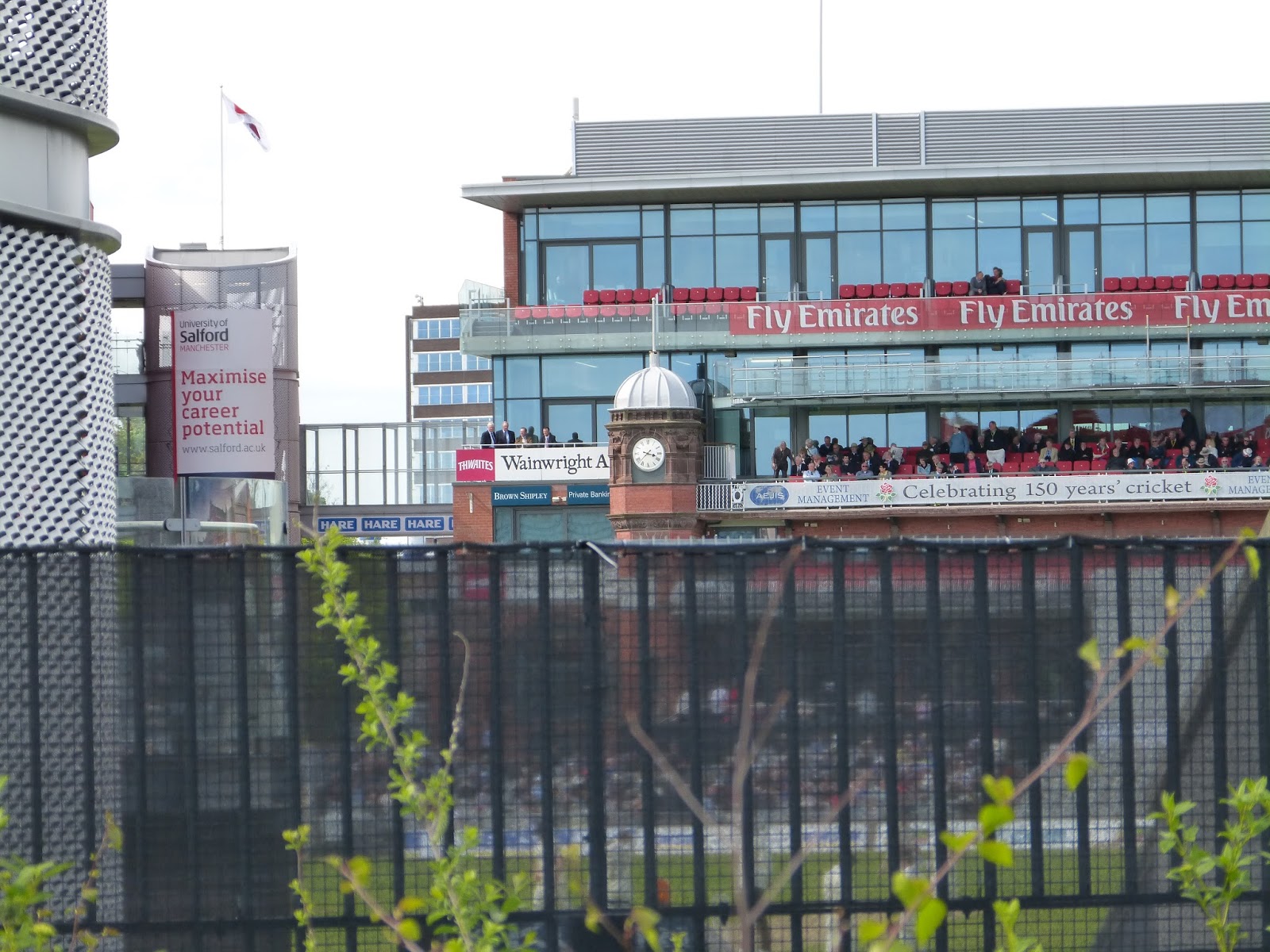
Continuing along Wilmslow Road brings you past the cricket ground. From the road the pavilion clock could just be made out using full zoom.


And finally on to this curiosity - a large free-standing clock tower on the edge of the Tesco supermarket site on Kingsway / Parrs Wood Lane. This is certainly not a usual design for Tescos - where its stores do have clocks they are normally on the main building.


The lamps and railings along the Kingsway frontage also didn't look they belonged to a modern supermarket.


The answer to this mystery? Well a bit of digging revealed that the tower is all that remains of the Parrs Wood bus depot, which was built in 1926 and extended in 1932. The depot was used as a munitions factory during WWII, and finally closed as a bus depot in 1971. Demolition, with the exception of the tower, followed in about 1980.


Monday, 22 June 2015

Manchester (Part 2 : Old Trafford)

The road to Old Trafford begins at, well, in my case Old Trafford tram stop. Heading towards the football stadium you are met by the imposing site of Trafford Town Hall and its solid, sturdy clock tower.


The building was officially opened on 16 September 1933, although it was originally known as Stretford Town Hall. Local government reorganisation in 1974 led to the change of name.


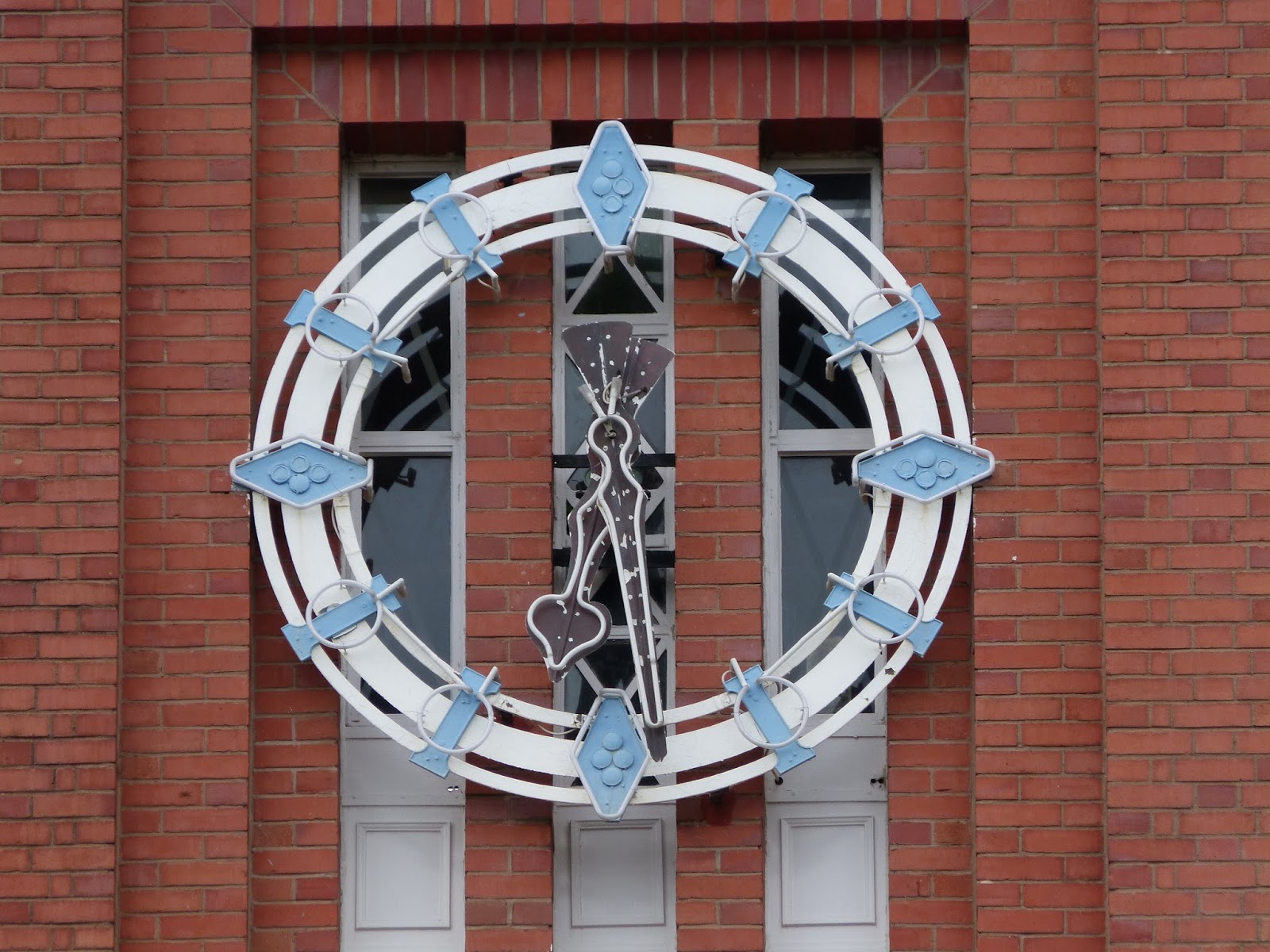
Although the clock face is quite impressive, with the hour dashes cheekily painted in Manchester City colours, the open nature of the dial set against the tower windows, and the design of the hands themselves, means that the overall visual effect is not as good as it could be and is certainly not good for telling the time at a glance. This is a clock that demands a good hard stare.


You will also notice, whilst giving your hardest, longest stare, that at least one face is not telling the correct time. So all in all, better to have your own watch in these parts.


Trafford Town Hall stands by one main road junction. At the next one in our northerly journey stands the motor dealers Evans Halshaw. (And note the pub sign that indicates we are on the right route to the football stadium).


This is one impressive clock, marred only by the poor positioning of the lamp column which does not obscure the face but detracts from the overall ambiance.


Now this is a clock where you can tell the time at a glance. The smaller dial, by the way (and the way in which it is by is Sir Matt Busby Way), is a thermometer.


Onwards then to Old Trafford stadium itself, home of course to Manchester United.


And the clock is of course a memorial to those killed in the Munich air crash in 1958.


Destination reached, it is now time to retrace my steps back to the tram stop. From where you can peek into the Lancashire County Cricket Ground to see its pavilion clock.


Friday, 19 June 2015

Manchester (Part 1 : City Centre)

I was convinced that I had already covered Manchester in this blog, but looking back, the last time I visited the city was just before I started Clock This. Posting number one, which was very much an experiment for me in being a contributor to the web rather just a consumer, covered Eccles but not the rest of Manchester. Therefore I had not prepared myself for a thorough hunt for public timepieces amongst the streets, squares, lanes and alleyways, with the result that this survey might not be as comprehensive as it could be.

So what you get is what you get (which may or may not be what you see). And re the picture below, I would love to get the chance to see bar food dancing - twiglets doing the tango perhaps, po-going peanuts or break dancing pork scratchings.

Sorry, off on a mad tangent again. Focus on the clocks. This is the Palace Hotel on Oxford Street.


Built in phases between 1891 and 1932, it includes this 66 metre clock tower.


Heading south now to the Victoria Baths on Hathersage Road, another gorgeous Victorian building.


What I love about these buildings are the traces of past social order. The entrance below is marked for "Males 1st Class", with similar entrances for "Males 2nd Class" and the equivalent ones for females. It would be interesting to know what differentiates a 1st class male from a 2nd class one.


At the other end of Hathersage Road, at its junction with Oxford Road, is St Mary's Hospital. the picture below is the view from Hathersage Road.


...whilst this is the Oxford Road frontage.


Opposite the building is the excellent Whitworth Gallery, part of the sprawling Manchester University complex. And next door to St Mary's is the Royal Infirmary.


Manchester Victoria railway station is having extensive rebuilding works, partially to provide better interchange with the tram network. This work has also opened up the view of the clock above the booking office.


Whilst outside, the station has two further clocks, one in the middle of the frontage on Victoria Station approach:


....and the other on the corner of Long Millgate.


From this point you can also look across to see this clock in Balloon Street.


The Printworks was, as you can probably guess, once the home of newspaper publishing. It is has since been converted into an entertainment venue.


The not so subtle Printworks sign looms above the city centre, detracted from the clock above.


The Royal Exchange is much more low key. The building is the latest in a long line of financial exchange buildings on the site, with this current incarnation being completed in 1921.


The building ceased its trading function as long ago as 1968, and now houses, amongst other things, a theatre.


Next door is the church of St Anne, consecrated in 1712. This side of the tower has a very plain clock face...


...whilst the opposite is much more ornate.


I always thought that Manchester Piccadilly station was sterile ground for clock hunting. But on travelling down to the tram, I found this clock buried in the bowels of the station complex.


And finally, a clock on the junction of Dale Street and Lever Street.