Monday, 24 August 2015

Hackney to Bethnal Green

Another London walk. the original intention was to go from Hackney Downs station to Bethnal Green, and then across to Shoreditch and ending once again at Liverpool Street station. But frankly it was so hot I gave up at Bethnal Green and jumped on the tube.

But before that there were a few clocks to see.
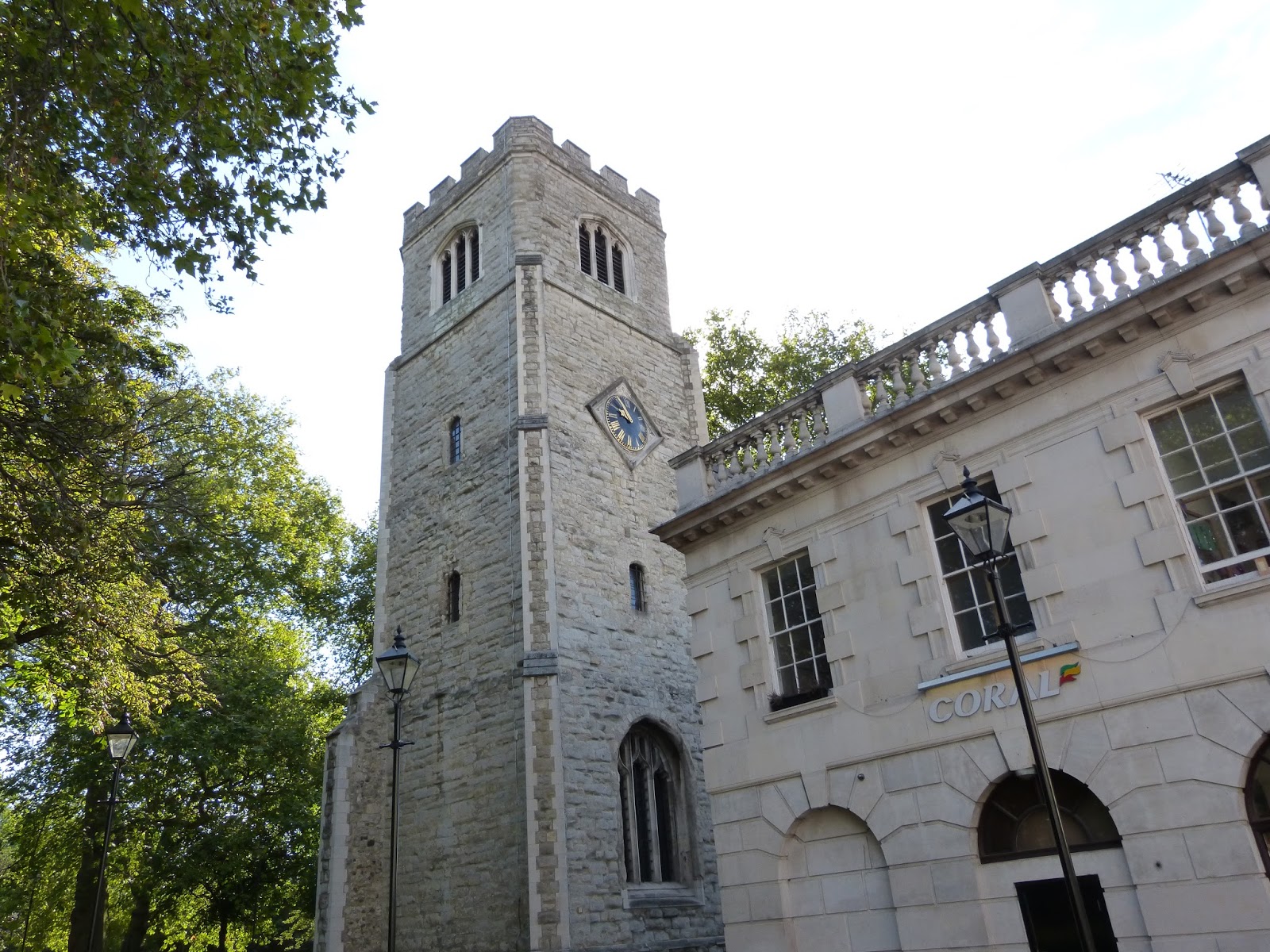

The first is on the tower of the church of Saint Augustine. Although the photograph above might suggest that this is a complete church, the building to the right is actually the Hackney old town hall.


As the plaque suggests, the tower is all that remains of the 13th century church (once belonging to the Knights of St John) that was demolished in 1798.


The tower stands in the churchyard gardens of St John at Hackney, the replacement church completed in 1797.


Heading south now on Mare Street, to the lovely Hackney Town Hall (opened July 1937).


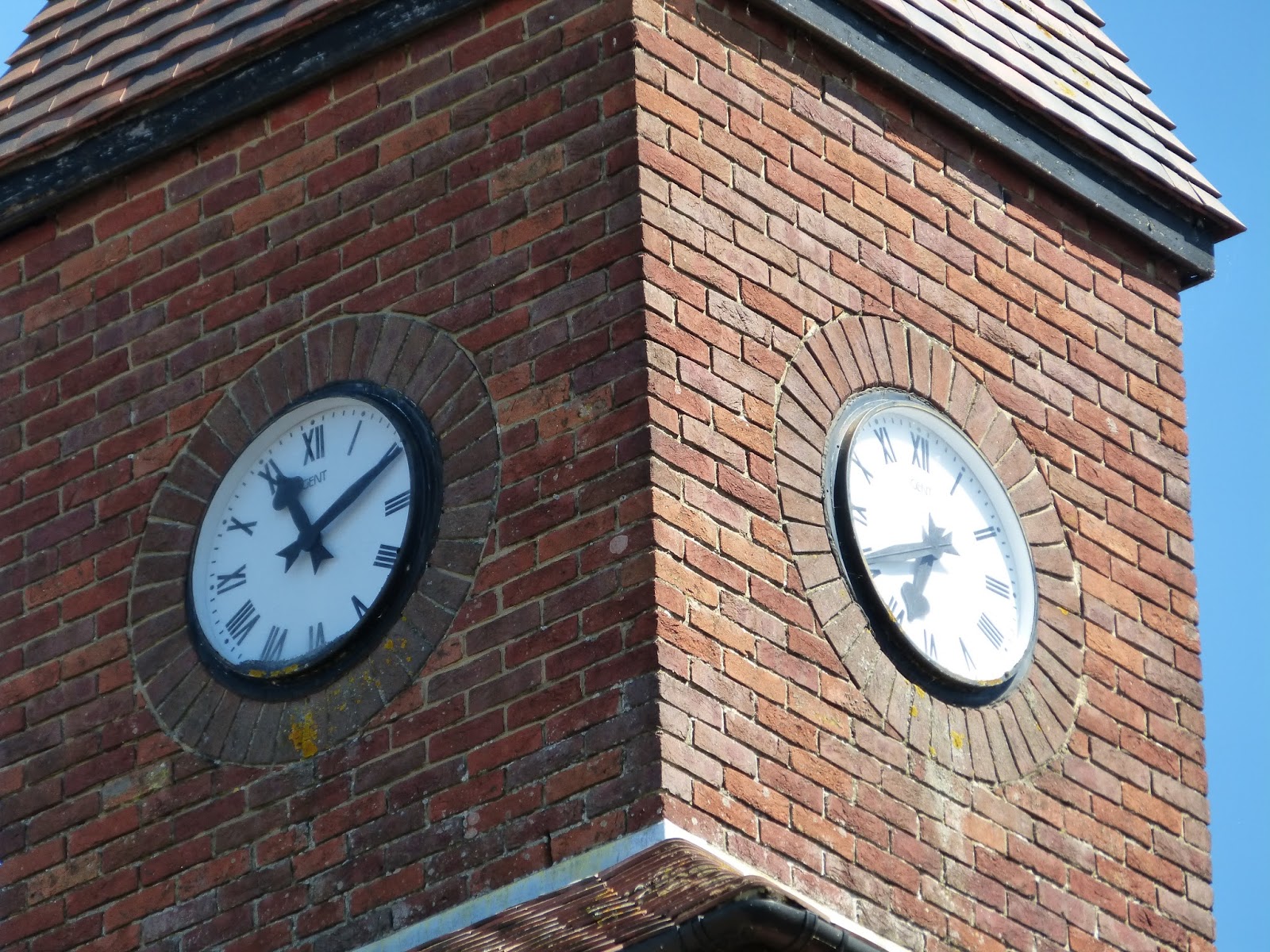
No, these aren't blurry photos. It is just the strength and angle of the sun casting very strong shadows of each of the numerals.


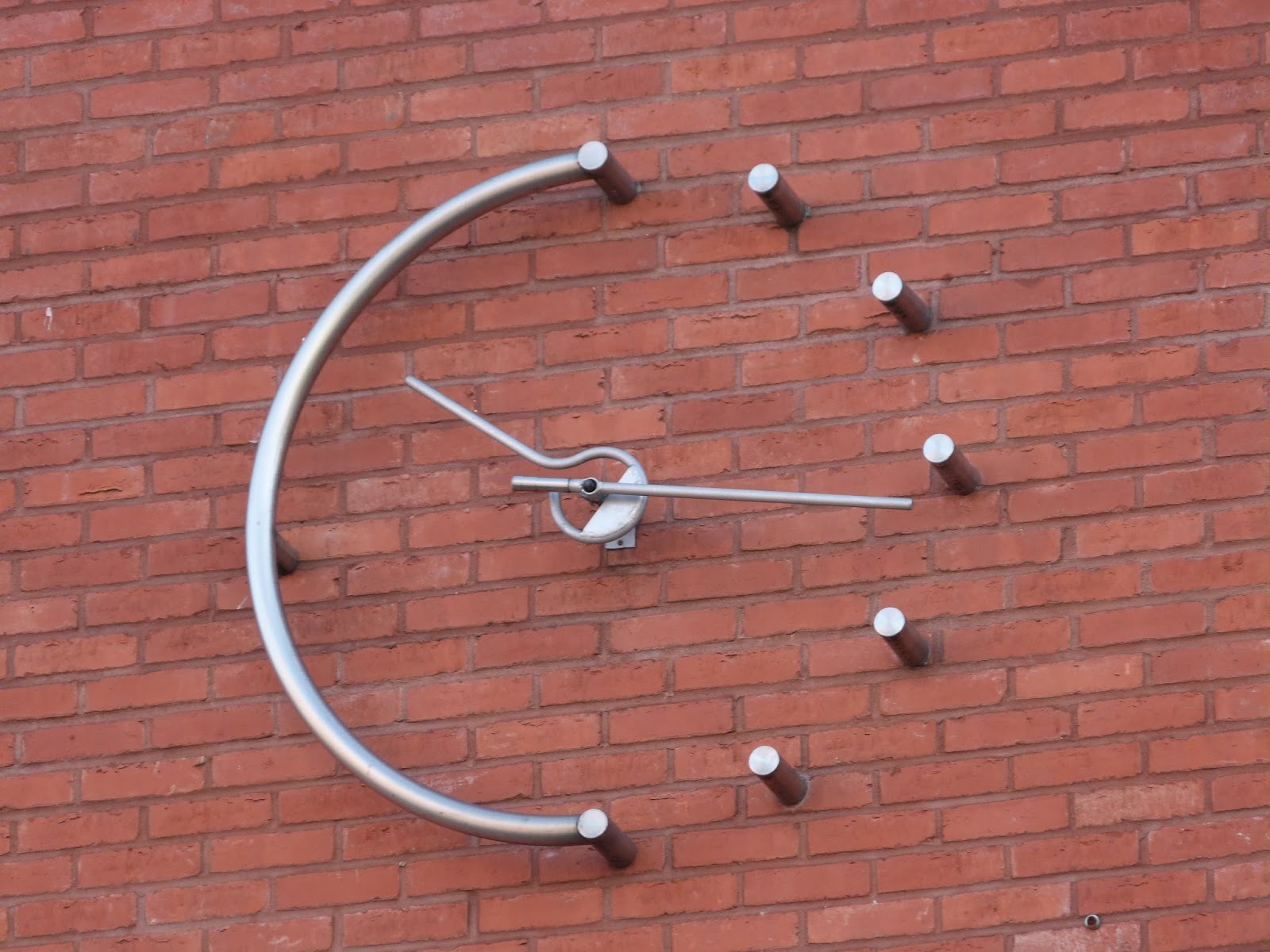
Standing opposite the Town Hall (and the next door Hackney Empire) is the Baxter's Court Wetherspoons pub. And this rather curious clock.



Continuing south, Mare Street becomes Cambridge Heath Road, and at the latter's junction with Roman Road stands St John on Bethnal Green (I've just realised that I could have called this posting St John to St John).
 

St John on Bethnal Green was designed by Sir John Soane, and was completed in 1828.


Finally, we move next door to Bethnal Green underground station. It is quite an odd sensation going down the steps, as this was the site on 3 March 1943 where 173 people were crushed to death as they rushed down to seek shelter in the partially built station when the air raid siren sounded. A memorial is being built in the adjacent park (www.stairwaytoheavenmemorial.org).

On a lighter note, there is a glorious clock on the platform. According to the book Underground Heritage (by Antony Badsey-Ellis, published by Capital Transport, 2012), this design (made by Magenta Time Company Ltd) was installed at four stations on the eastern extension of the Central Line opened in the 1940s - the others being Gants Hill, Redbridge, and Wanstead. Bethnal Green station opened in December 1946.


This example at Bethnal Green was refurbished in 2009 with a polished brass case.

Friday, 21 August 2015

Salisbury

Time to catch up with some visits carried out earlier this summer. This is Salisbury, which chronologically should follow the Southampton posts, but hey, sometimes life demands a more messy approach to recording the passing of history. Unless something drastic has happened which has been hushed up by all the main news media in some pointless conspiracy, Salisbury and its clocks are still there (which now means that there will be some strange people out there who now firmly believe that the entire town has been beamed up by aliens under the control of Elvis and replaced by a hologram. And talking of Elvis, did you know that if you play his records backwards they sound just like Black Sabbath tracks?).


Just to the north of the station is the church of St Paul's, consecrated in 1853.


Of a more recent vintage is the clock tower of the Sainsbury's supermarket. A fairly simple clock on a very uninspiring tower, but it is there and so is included here.


Much more inspiring, and my reason for visiting Salisbury, is the clock tower by Fisherton Bridge
.


The clock tower is a memorial to the wife of Dr John Roberts, and was completed in June 1893.


The clock itself is by Smith of Derby. The original mechanism was replaced in December 1970.


Next up is the entrance to Market Walk. Salisbury was granted the right to hold a market by King Henry III in 1227, but I am guessing that this building and its clock are slightly (!) later in date.


I love this next clock in New Canal Street.


Its rather dilapidated state lends it a form of dignity and gravitas. And Electric House - what a great name compared to the rubbish ones you get on more modern buildings. I assume it had some connection with its original use (Electricity Board?), but is now a branch of Blacks the outdoor clothing retailer - will it be re-named Hiking House?


Even more lovely is the W H Smith clock on what is now a branch of Waterstones. The building was originally the Assembly Rooms, but was bought by W H Smith in 1924.


Although not all the hands are in the condition they are meant to be, the glorious colour of the clock face makes it a wonder to behold, and one of my favourite clocks of all time.


The weathervane apparently represents a W H Smith newsboy.


Finally, St Thomas of Canterbury church. This is located right in the heart of the town and is hard to find how to get close to it.


And after walking round and round and being blocked by other buildings, you finally notice the little alleyways that lead to the church, the main one being indicated by the sign below.


The sign also indicates that the church dates from 1220, although most of the actual building dates from the 15th century.