Showing posts with label Guildhall. Show all posts

Friday, 18 August 2017

Hull (Part 1)

Kingston upon Hull, normally known as Hull, is an oft-forgotten city, being on the road to nowhere else. But this year it is the UK City of Culture, so consider this my contribution to the artistic activities.

Before we delve into the clocks, I must say that the city is making a fine job of its City of Culture status, with a huge range of activities and an army of volunteers who are fantastic ambassadors for the area. For further information see www.hull2017.co.uk.

Hull Trains let me down by cancelling my booked service, but I got there eventually by means of Grand Central trains and a coach.

Arrival is at Paragon station, which originally dates from the 1840s, with the current buildings dating from 1904. The only clock on the concourse is this small clock tower, which I assume is a relatively recent addition.


Near it is a replica Gipsy Moth, recording the aviation feats of local hero Amy Johnson. Also to be seen are the blue hoardings around the building works, which at times including ear-splitting drilling noise. Not currently the place for quiet reflection.


Coming out of the station, we are met with another clock, with House of Fraser in the background.


A nice simple clock with clear Arabic numerals, which looks really good in the sunshine.


We move into the city centre, passing the Grand Buildings on Jameson Street. Nothing very grand about the building, but I will let that pass as it has both a clock and a branch of Waterstones.


Moving on, this is Queen's House on Paragon Street, dating from 1952 as Hull started to be re-built after extensive bombing damage during the war.


The Maritime Museum stands proudly and elegantly on Queen Victoria Square.


This building was originally the offices of the Hull Dock Company, built in 1868-71, and replacing offices on the High Street which we will come to in Part 2. This newer building was converted into a museum in 1975. If you get a chance to visit the museum before the 24 September, make sure that you watch the video in the "A Common Foe" exhibition, a powerful piece about the interaction between the Hull and Icelandic fishing industries.


Our next clock is on the corner façade of what was the Co-op, and then BHS, and now with the collapse of the latter chain an empty store on Jameson Street.


On the other end of the building is this massive and magnificent mosaic by Alan Boyson from 1963. It has recently been turned down for listing by Historic England and so with BHS being empty it is currently under threat.


Going back to the other end, there is a face-off (dial-off?) between the ex-BHS clock and an ex-Lloyds bank clock on the other side of the road.


This is a beautiful clock in its simple design and glorious colour scheme. I just hope that it is retained by the new owners of the building.


We are now in Queen's Gardens, which until 1930 was part of the dock complex. The impression of the dock is retained by the gardens being sunken a few feet below the surrounding streets.


Whilst the gardens, designed by Frederick Gibberd, are pleasant, the Gosschalks building on the north side is totally uninspiring, with a clock added as a bit of an afterthought. Gosschalks are a commercial law firm.


Rather more impressive is the Guildhall of 1913 -16. I have focussed on just the clock tower, but the whole building is a grand expression of civic pride.


Part 2 coming soon.


Sunday, 18 September 2016

Open House London 2016

This weekend has been the annual Open House London time, with 750 buildings open to the public.

As usual, a big thanks goes to the overall organisers (see www.openhouselondon.org.uk), all the building owners, the staff and the volunteers for making this such a great event.

This is my record of the clocks that I saw at or from the buildings I visited.

Also, I thought that I knew the City of London pretty well in terms of its clocks, but on my wanderings between buildings I spotted five clocks which I hadn't previously recorded. These will be shown in later postings - in fact I feel that the time has come to have a post for every single public clock in the City of London, so watch this space. And judging by this weekend's experience, I will need your help in finding the ones that I don't know about. Any guesses yet for how many clocks there are in the City?

My buildings this year were St Paul's, St Lawrence Jewry, a talk at the Guildhall City Centre, St George's Bloomsbury, St Botolph's  Building, Holland House, St Botolph's church, Bevis Marks Synagogue and Drapers Hall.

So, we start with St Paul's Cathedral. I don't I need to say anything about the building, but here is its clock:


St Lawrence Jewry sits by the Guildhall, and is a 17th century building by Sir Christopher Wren (and hence linked to St Paul's) - although the interior is a more modern refurbishment following extensive damage in World War II.


And thank you to the volunteer who informed me that the ornate gilded ironwork in front of the Lord Mayor's pew was of course a sword rest.


Taking an excursion outside of the City, my next stop is St George's Bloomsbury in Bloomsbury Way.


This is one of Nicholas Hawksmoor's 18th century masterpieces.


And in typical Hawksmoor style is fantastically bonkers. The tower has a steeple based on the design of the Mausoleum of Halicarnassus, topped with a statue of George I...


...and a lion and a unicorn thrown in for good measure.


The St Botolph Building is at 138 Houndsditch (always great road names in the City), and is a 52,000 square metre floorspace office building completed in 2010.


No clocks on this building, but you can spot a few out of the windows of the thirteenth floor:

Christchurch, Spitalfields (another Hawksmoor theatrical creation)-


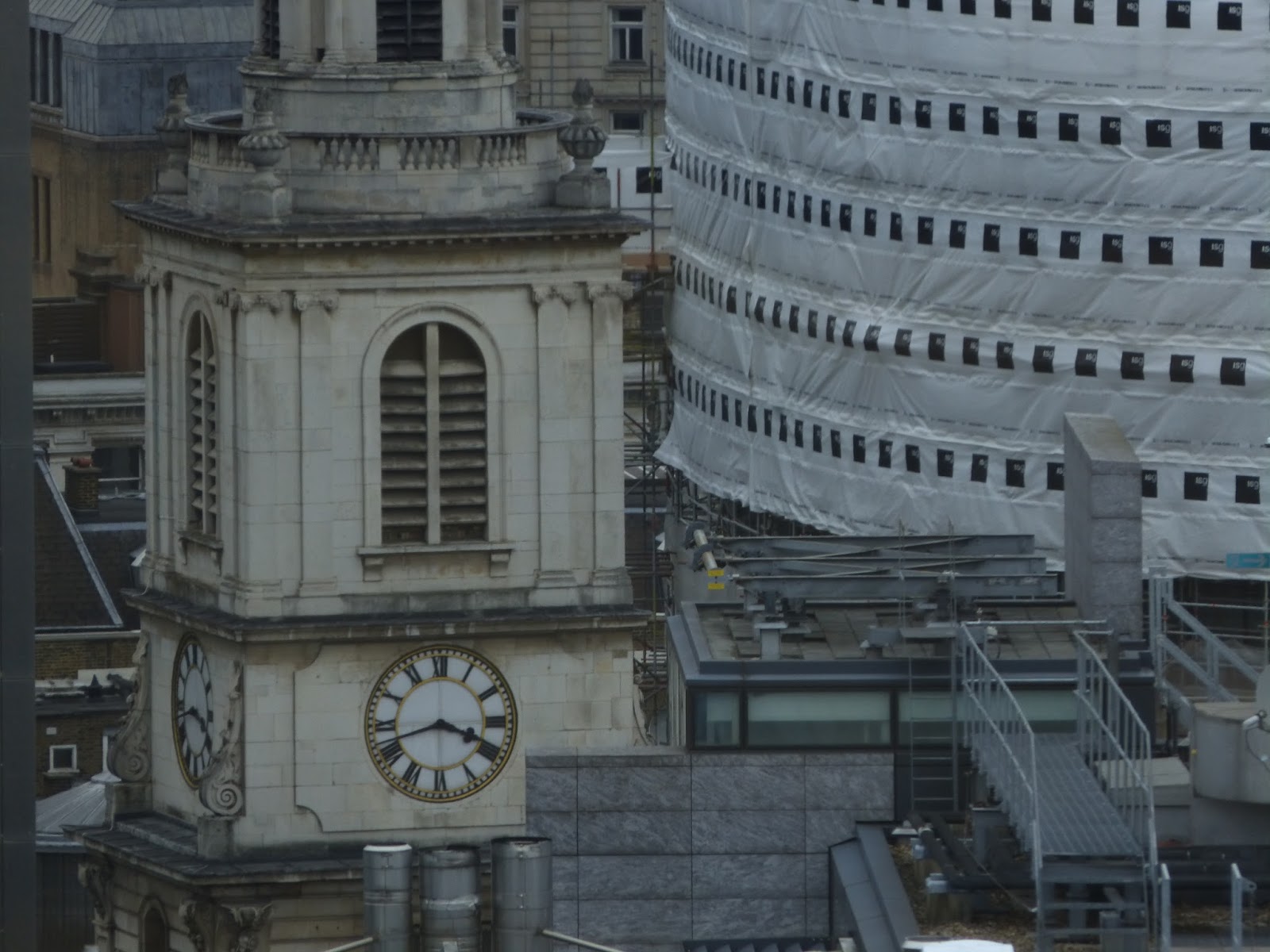
St Botolph, Bishopgate -


and Liverpool Street station -


And all credit to Clyde & Co LLP for opening up their office floor, and for displaying a collection of artwork from students from London arts colleges (www.artawards.clydeco.com).

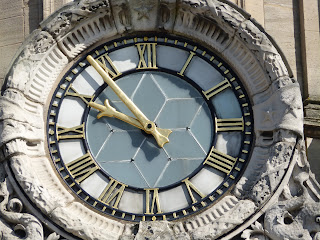
The colour of the building was supposedly chosen to match the centre of the clock on nearby St Botolph Aldgate:


St Botolph Aldgate is by George Dance the Elder, and dates from the 1740s.

Next up is another place of worship, Bevis Marks Synagogue, dating from 1701 and the oldest synagogue in Britain.


And finally on to Drapers Hall in Throgmorton Street. This is one of the City's livery halls, and originally dates back to the 1530s, although with subsequent rebuilding. The magnificent interior is mostly Victorian.
This is the Livery Hall...


...with a clock on the right hand side of the end wall..


..and a wind direction gauge on the left hand side.


The Drawing Room has this clock in the fireplace:


I now wait for Open House London 2017.