Showing posts with label Hawksmoor. Show all posts

Sunday, 18 September 2016

Open House London 2016

This weekend has been the annual Open House London time, with 750 buildings open to the public.

As usual, a big thanks goes to the overall organisers (see www.openhouselondon.org.uk), all the building owners, the staff and the volunteers for making this such a great event.

This is my record of the clocks that I saw at or from the buildings I visited.

Also, I thought that I knew the City of London pretty well in terms of its clocks, but on my wanderings between buildings I spotted five clocks which I hadn't previously recorded. These will be shown in later postings - in fact I feel that the time has come to have a post for every single public clock in the City of London, so watch this space. And judging by this weekend's experience, I will need your help in finding the ones that I don't know about. Any guesses yet for how many clocks there are in the City?

My buildings this year were St Paul's, St Lawrence Jewry, a talk at the Guildhall City Centre, St George's Bloomsbury, St Botolph's  Building, Holland House, St Botolph's church, Bevis Marks Synagogue and Drapers Hall.

So, we start with St Paul's Cathedral. I don't I need to say anything about the building, but here is its clock:


St Lawrence Jewry sits by the Guildhall, and is a 17th century building by Sir Christopher Wren (and hence linked to St Paul's) - although the interior is a more modern refurbishment following extensive damage in World War II.


And thank you to the volunteer who informed me that the ornate gilded ironwork in front of the Lord Mayor's pew was of course a sword rest.


Taking an excursion outside of the City, my next stop is St George's Bloomsbury in Bloomsbury Way.


This is one of Nicholas Hawksmoor's 18th century masterpieces.


And in typical Hawksmoor style is fantastically bonkers. The tower has a steeple based on the design of the Mausoleum of Halicarnassus, topped with a statue of George I...


...and a lion and a unicorn thrown in for good measure.


The St Botolph Building is at 138 Houndsditch (always great road names in the City), and is a 52,000 square metre floorspace office building completed in 2010.


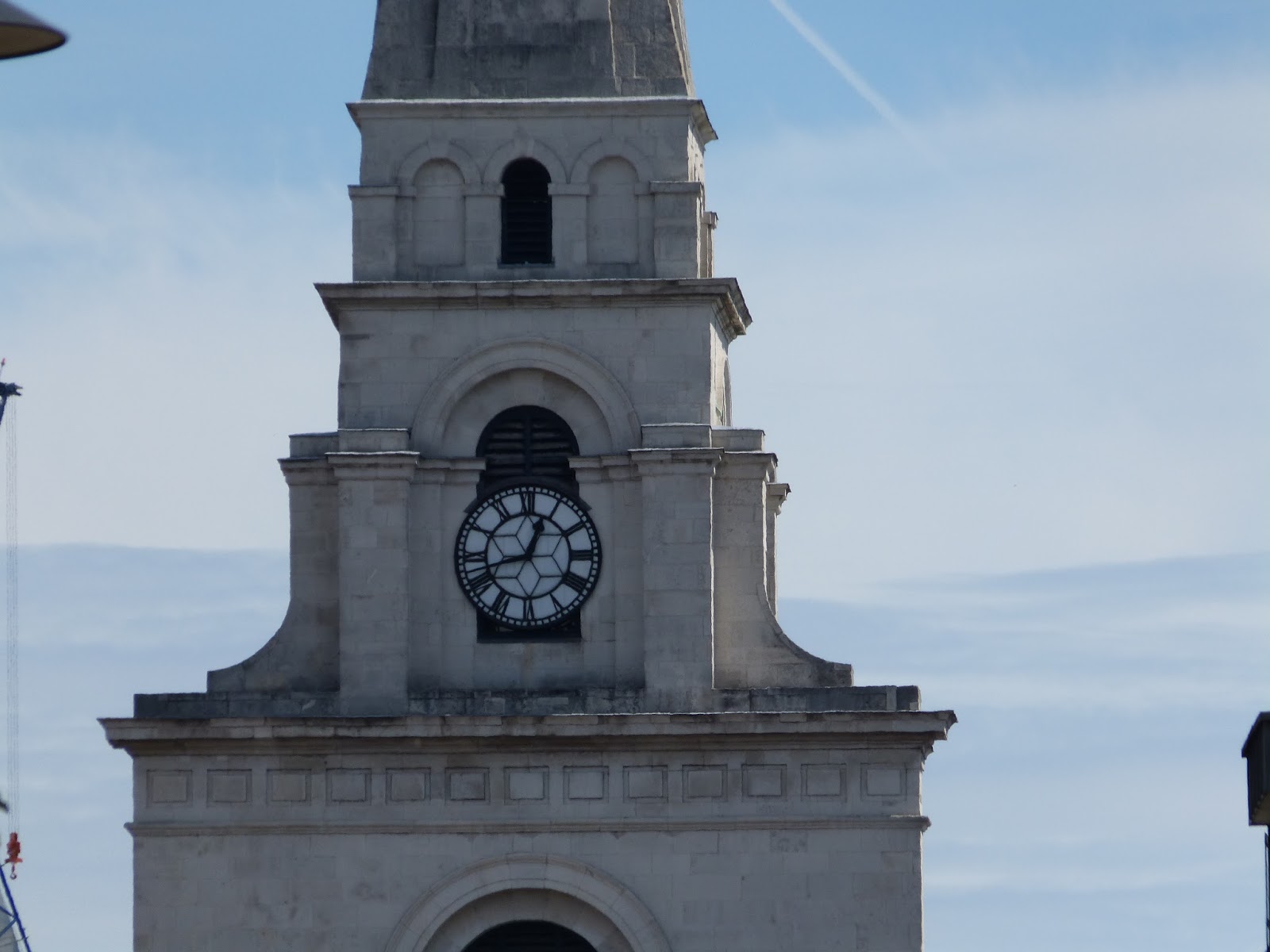
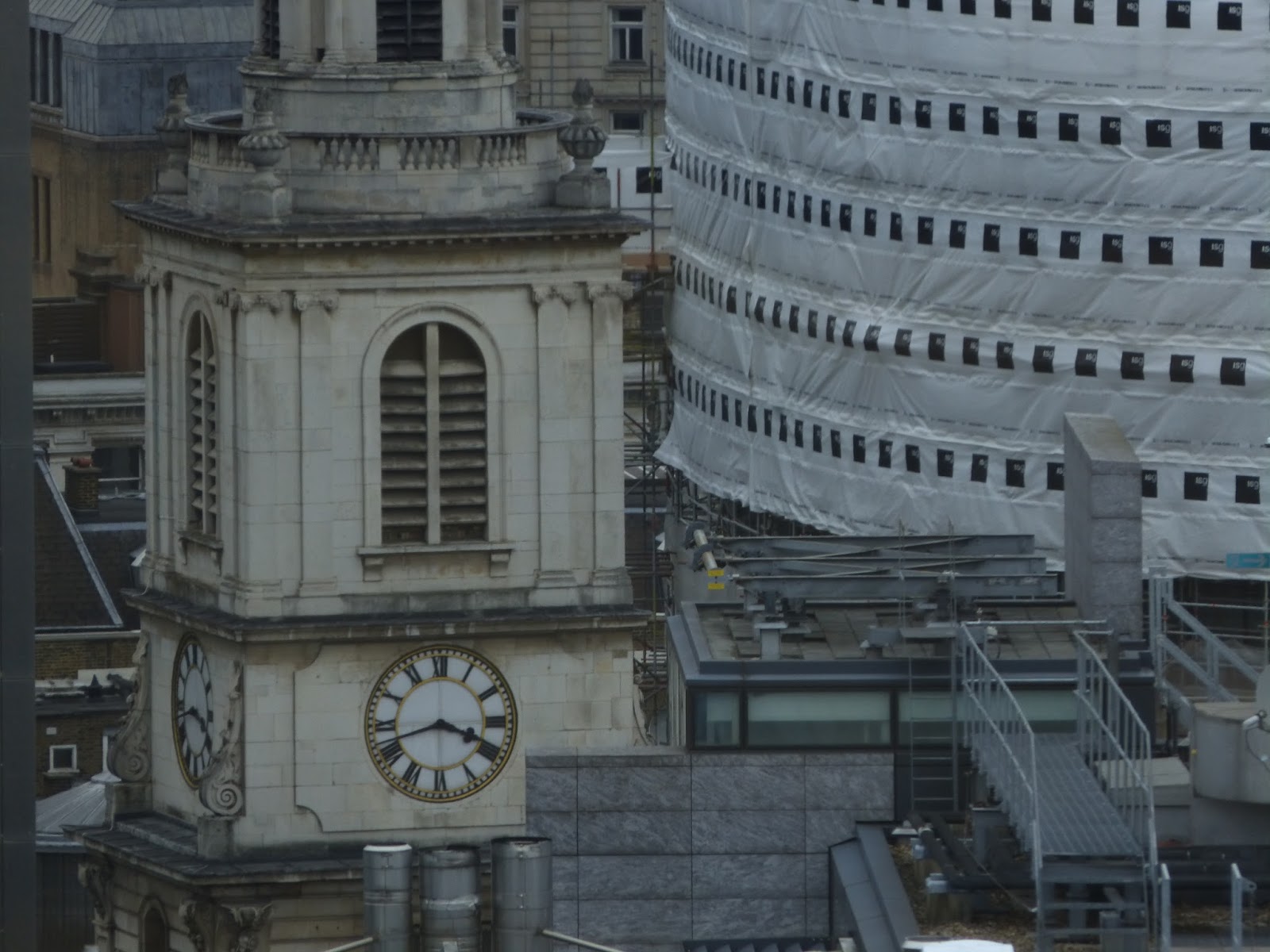
No clocks on this building, but you can spot a few out of the windows of the thirteenth floor:

Christchurch, Spitalfields (another Hawksmoor theatrical creation)-


St Botolph, Bishopgate -

and Liverpool Street station -


And all credit to Clyde & Co LLP for opening up their office floor, and for displaying a collection of artwork from students from London arts colleges (www.artawards.clydeco.com).

The colour of the building was supposedly chosen to match the centre of the clock on nearby St Botolph Aldgate:


St Botolph Aldgate is by George Dance the Elder, and dates from the 1740s.

Next up is another place of worship, Bevis Marks Synagogue, dating from 1701 and the oldest synagogue in Britain.


And finally on to Drapers Hall in Throgmorton Street. This is one of the City's livery halls, and originally dates back to the 1530s, although with subsequent rebuilding. The magnificent interior is mostly Victorian.
This is the Livery Hall...


...with a clock on the right hand side of the end wall..


..and a wind direction gauge on the left hand side.


The Drawing Room has this clock in the fireplace:


I now wait for Open House London 2017.


Friday, 7 August 2015

An East London Walk

One of the (many) great things about London is that a walk of any reasonable distance will yield sightings of at least one or two clocks.

Today's stroll is from Highbury and Islington station to Liverpool Street, via the Kingsland Road (which forms part of the A10 between the Monument and Kings Lynn). Our journey starts on numerically superior A1199, aka St Paul's Road, where the following building can be found at the junction with Essex Road.


This you would rightly surmise as being St Paul's church. Or indeed wrongly surmise as the passage of time has seen this edifice morph into becoming the St Paul's Steiner school.


The church, now a Grade II* listed building, was designed by Charles Barry and completed in 1828. It subsequently became redundant in 1980, and remained unused for many years before being taken over by the Steiner School project.


Incidentally, before the building of the church, the road was known as Hopping Lane.


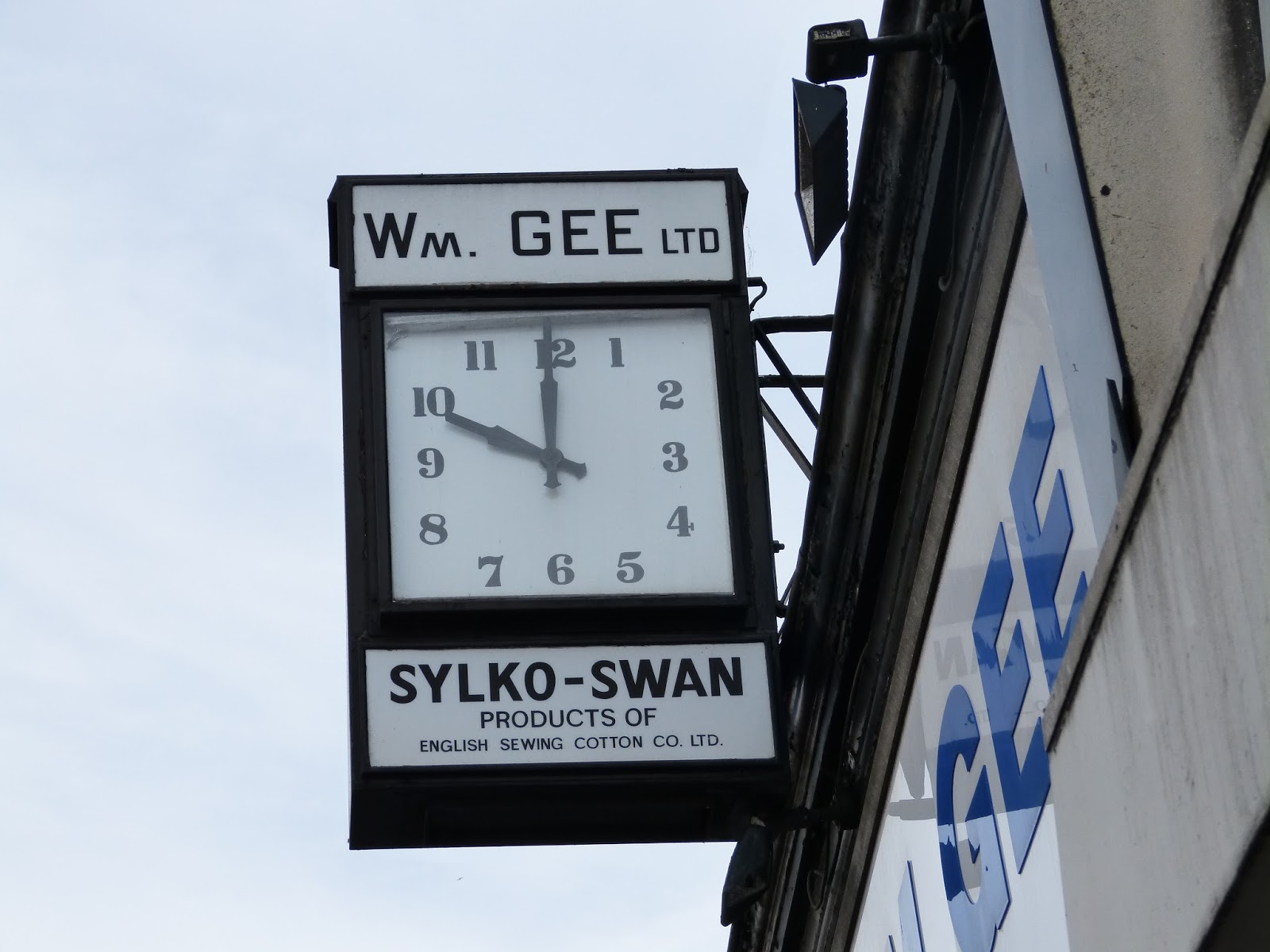
Ok, we are now heading south towards the metropolitan centre on the Kingsland Road. More specifically, 520 - 522 Kingsland Road, the home of William Gee Ltd. the company, established in 1906, is described on its website as the "leading stockist and distributor of textile trimmings and haberdashery products in the UK". I have always loved the word haberdashery, so any company in the trade which has a clock outside their premises gets my vote.


Just a shame the clock is not working (a phrase I unfortunately have to use all too often in this blog).


Moving south, this industrial building is set just off the main road.


The clock is now in a poor state, but its substantial nature suggests that this was home to an important company. Does anybody know anything about this building?


A few doors down at the junction with Englefield Road we come across a very interesting clock.


This KTS The Corner, aka T J O'Kane Builders. Its three-faced clock has various bits of building kit instead of numerals, with a different set on each face. This is certainly something different.


Strolling every southwards along Kingsland Road, a church clock down a side road catches my eye.


Closer inspection reveals a completely different world to the busy and commercial Kingsland Road, this world being De Beauvoir Town which was built as a model village in the 1840s (that is model as in blueprint or exemplar rather than a scaled down version of real life - it would have been rather scary if I had suddenly become a giant). Incidentally I have just finished reading a book called "Dreamstreets - A journey through Britain's village utopias" by Jacqueline Yallop, which covers these model villages, but not De Beauvoir Town.


The church is the wonderfully titled St Peter De Beauvoir Town, completed in 1841.


Southwards, ever southwards, as the Kingsland Road continues to throw up all sorts of delightful surprises. One of its gems is undoubtedly the Geffrye Museum, which "explores the home from 1600 to the present day". Entry to this oasis of tranquillity is free. So pay a visit now (but please leave a donation).


The Geffrye also has an excellent café which provided much needed refreshment on my walk. Coffee and chocolate cake in a cool, quiet café, the sun shining, a gentle breeze playing softly round the tables, reading the newspaper, the murmur of other people's conversations - ah, paradise in Hoxton.


Refreshed, it is time to march on. The next find is St Leonard's church, at the point where Kingslands Road become Shoreditch High Street.


St Leonards was opened in August 1740. it has a 192 feet tall steeple, and was the first London church to be lit by gaslight (in 1817). It is also one of the members of the Oranges and Lemons gang - "When I grow rich, say the bells of Shoreditch".


It is also unusual in that it has a clock over its main entrance (as shown above), and also one on its tower (partially obscured by the trees).


And a different style of clock face on its southern aspect:


It's 12 o'clock and coming up for lunchtime, but on Shoreditch High Street it is Time for Tea.


Although actually no time at all, when you have a clock with no hands.


Time for Tea is "a five story event space and location hire on Shoreditch High Street which specialises in period production between 1939 - 1959" (which is surely supper time!).


Its neighbour is the Ace Hotel at 100 Shoreditch High Street - for no good reason I seem to be compelled to type Shoreditch High Street.


We are now getting near the end of our journey. But another interesting clock on a building I know nothing about.


And then a quick glance to the left reveals a distance view of Hawksmoor's Christ Church.


Another glance to the left along Middlesex Street gives us the Astral House clock.


And then we are finally at out destination, Liverpool Street station.


Ah, but wait. just to the south we can also see the clock on St Botolph.


But now let's finish our walk, and catch the train at Liverpool Street.