Showing posts with label St George. Show all posts

Sunday, 18 September 2016

Open House London 2016

This weekend has been the annual Open House London time, with 750 buildings open to the public.

As usual, a big thanks goes to the overall organisers (see www.openhouselondon.org.uk), all the building owners, the staff and the volunteers for making this such a great event.

This is my record of the clocks that I saw at or from the buildings I visited.

Also, I thought that I knew the City of London pretty well in terms of its clocks, but on my wanderings between buildings I spotted five clocks which I hadn't previously recorded. These will be shown in later postings - in fact I feel that the time has come to have a post for every single public clock in the City of London, so watch this space. And judging by this weekend's experience, I will need your help in finding the ones that I don't know about. Any guesses yet for how many clocks there are in the City?

My buildings this year were St Paul's, St Lawrence Jewry, a talk at the Guildhall City Centre, St George's Bloomsbury, St Botolph's  Building, Holland House, St Botolph's church, Bevis Marks Synagogue and Drapers Hall.

So, we start with St Paul's Cathedral. I don't I need to say anything about the building, but here is its clock:


St Lawrence Jewry sits by the Guildhall, and is a 17th century building by Sir Christopher Wren (and hence linked to St Paul's) - although the interior is a more modern refurbishment following extensive damage in World War II.


And thank you to the volunteer who informed me that the ornate gilded ironwork in front of the Lord Mayor's pew was of course a sword rest.


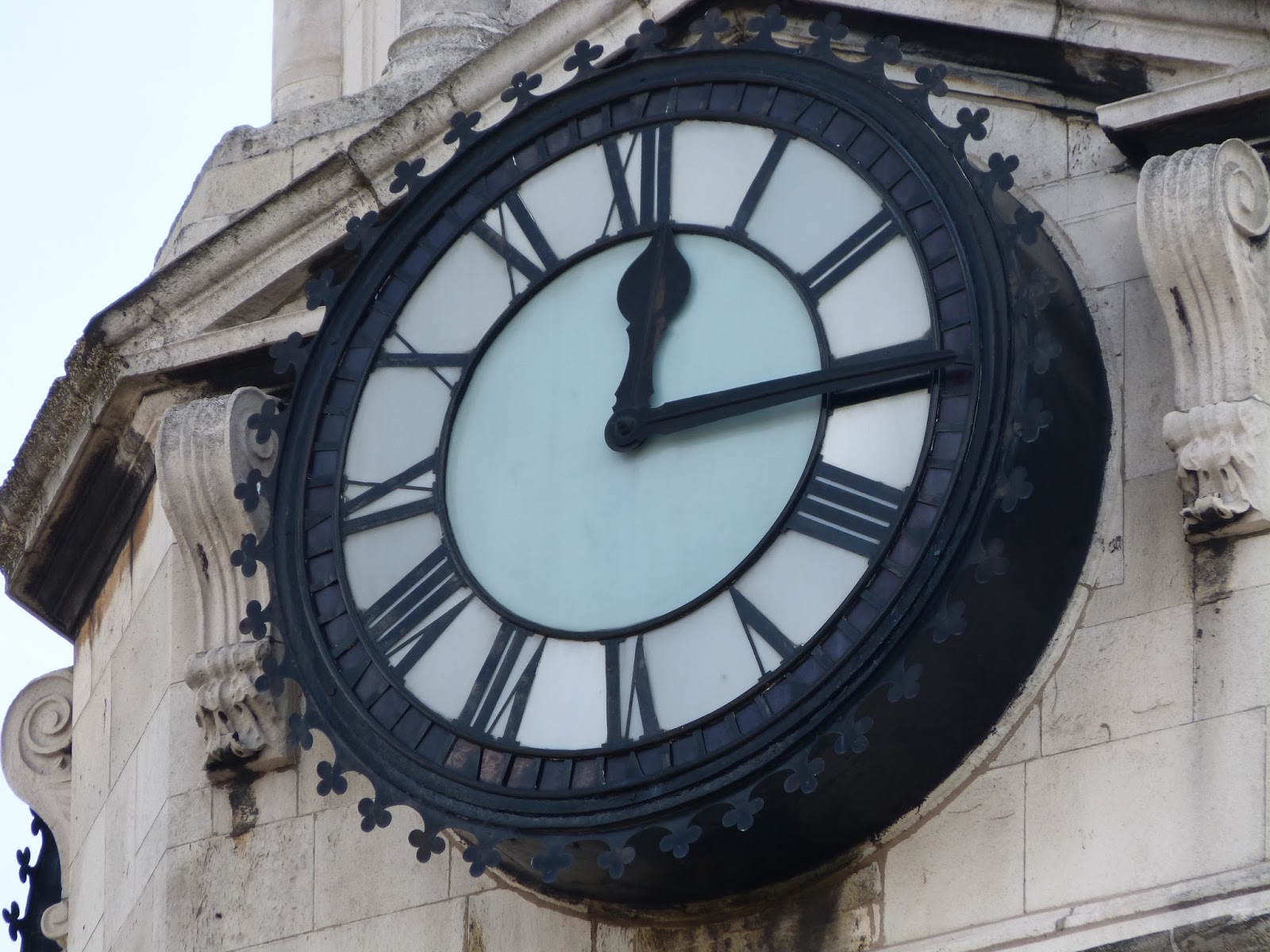
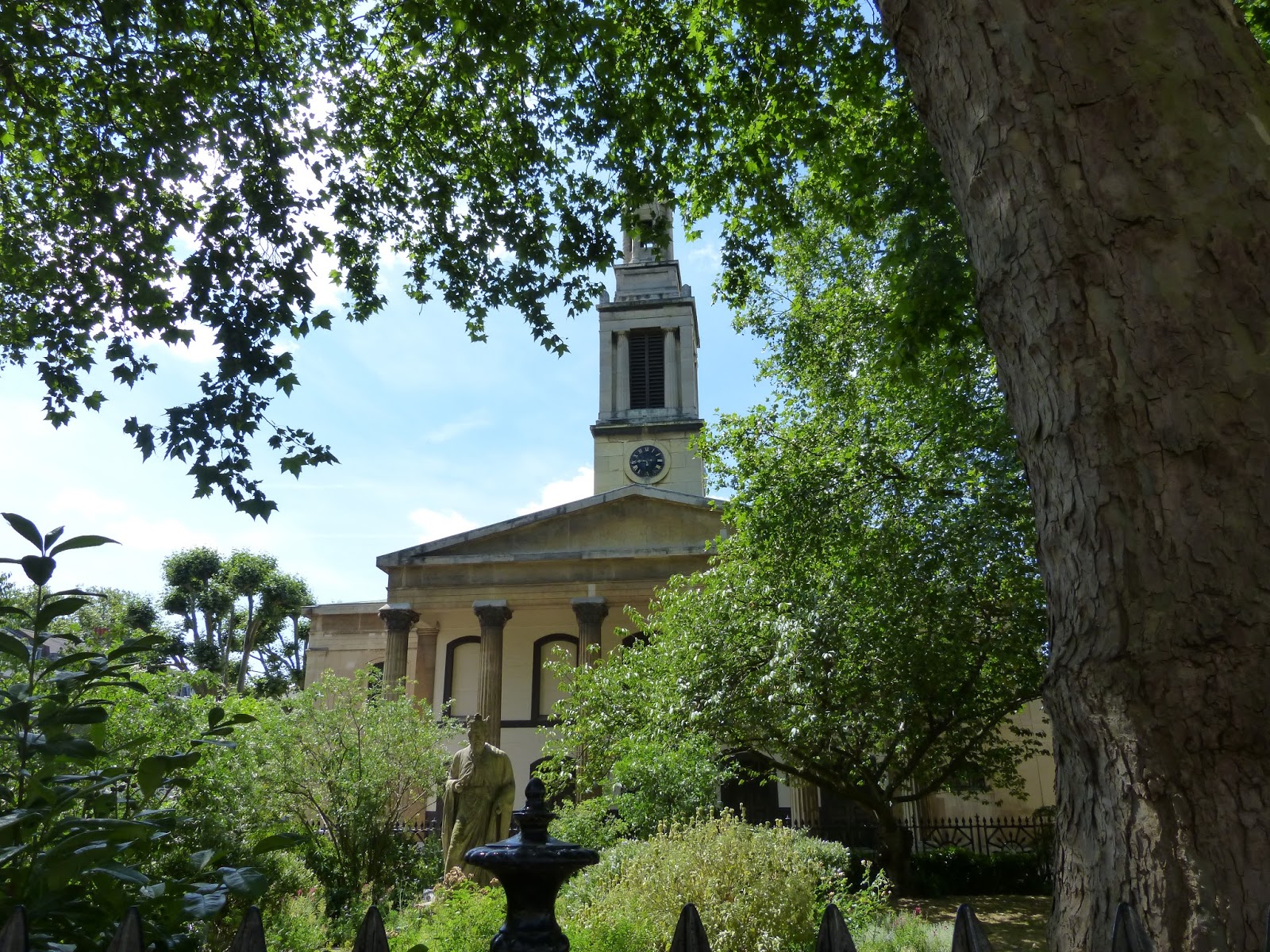
Taking an excursion outside of the City, my next stop is St George's Bloomsbury in Bloomsbury Way.


This is one of Nicholas Hawksmoor's 18th century masterpieces.


And in typical Hawksmoor style is fantastically bonkers. The tower has a steeple based on the design of the Mausoleum of Halicarnassus, topped with a statue of George I...


...and a lion and a unicorn thrown in for good measure.


The St Botolph Building is at 138 Houndsditch (always great road names in the City), and is a 52,000 square metre floorspace office building completed in 2010.


No clocks on this building, but you can spot a few out of the windows of the thirteenth floor:

Christchurch, Spitalfields (another Hawksmoor theatrical creation)-


St Botolph, Bishopgate -
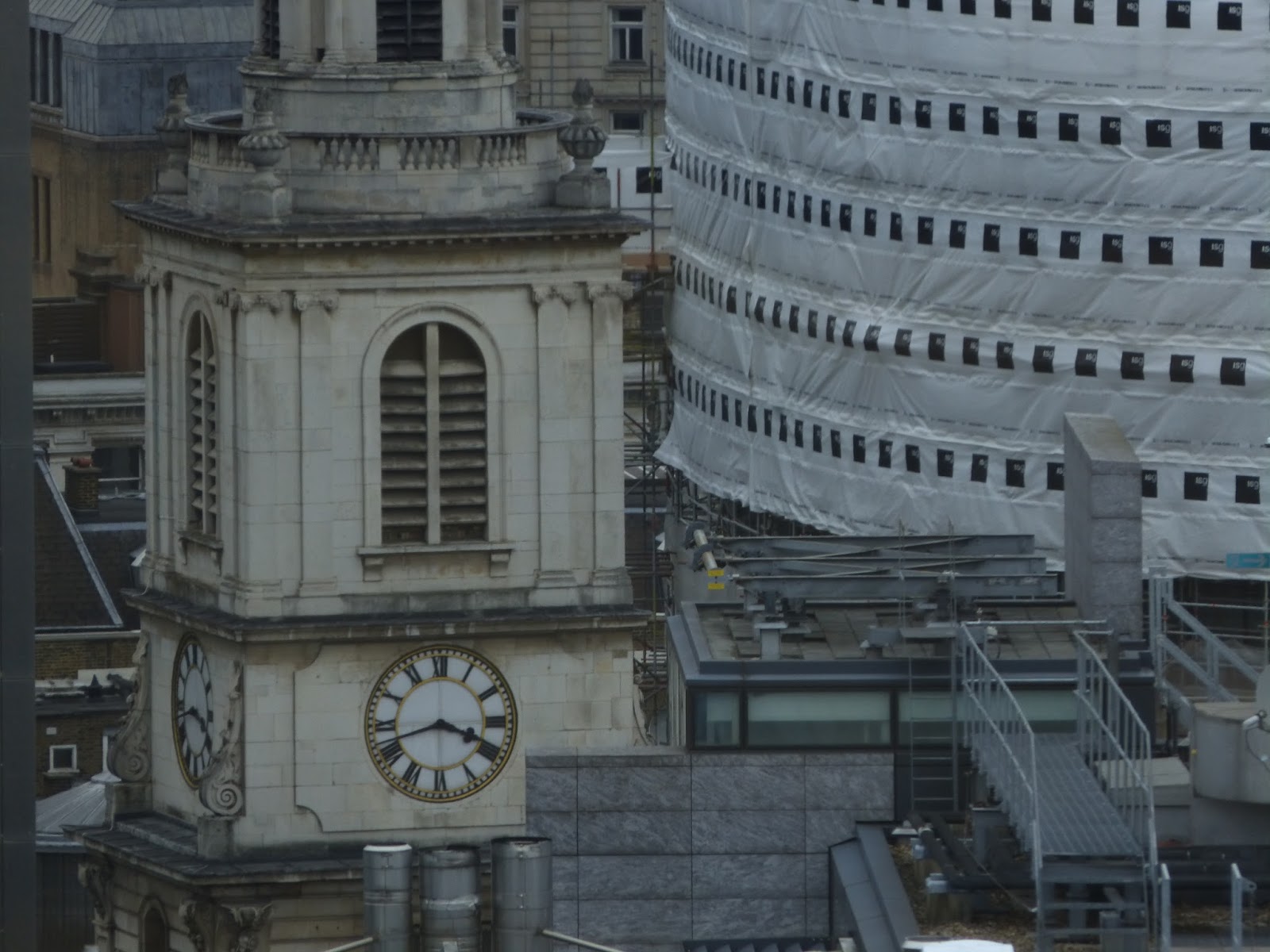

and Liverpool Street station -


And all credit to Clyde & Co LLP for opening up their office floor, and for displaying a collection of artwork from students from London arts colleges (www.artawards.clydeco.com).

The colour of the building was supposedly chosen to match the centre of the clock on nearby St Botolph Aldgate:


St Botolph Aldgate is by George Dance the Elder, and dates from the 1740s.

Next up is another place of worship, Bevis Marks Synagogue, dating from 1701 and the oldest synagogue in Britain.


And finally on to Drapers Hall in Throgmorton Street. This is one of the City's livery halls, and originally dates back to the 1530s, although with subsequent rebuilding. The magnificent interior is mostly Victorian.
This is the Livery Hall...


...with a clock on the right hand side of the end wall..


..and a wind direction gauge on the left hand side.


The Drawing Room has this clock in the fireplace:


I now wait for Open House London 2017.


Sunday, 19 July 2015

South London Church x3

A recent trip to the Marc Quinn exhibition (love the sculptures, not so keen on the other works) at the magnificent White Cube gallery in Bermondsey took me passed three clock be-decked churches, and hence they have been grouped together in this posting.

Two of the churches were familiar to me from previous visits to the White Cube and other forays south of the river (apparently the ancient bye law,  much quoted by London cabbies, of not travelling south of the river does not apply during daylight hours). The third one was found on a serendipitous diversion.

The first of the trio (or I suppose I should call it a trinity) is opposite Borough tube station. This is St George the Martyr.


The church dates from 1736, but is now dominated by much more modern architecture. And in particular the Shard, which can be seen as a backdrop to all three churches in this survey.


There are subtle difference in the clock faces on the southern and western aspects. Both are similar in size, colour and the use or a decorated surround.

 
The difference is in the design of the numerals and the hands, both of which are more decorative on the southern face....
 
 
....than they are on the western face.


The walk to the White Cube takes you along Long Lane and then left into Bermondsey Street, where you immediately come upon church number two - St Mary Magdalen.


This is more hemmed in than St Georges, and has two identical clock faces visible to those going up and down Bermondsey Street. The adjacent churchyard is now a haven of a small park, from where you can see the shard rising up again in the distance.


There has been a church on the site since 1290, but the present building dates from 1690 with additions in 1705 and 1794, and major alterations in 1830.


The clock, by the way, is not currently working.


To vary my trip, I walked back to Borough station via Great Dover Street. About halfway along, there is a divergent road called Trinity Street - could that be trinity as in Holy Trinity church, and hence the possibility of a clock? Only one way to find out of course.

To which I was rewarded with a very British / London sight - a square enclosed with railings, with nearby traditional red post box and telephone box. The big difference from most other London squares is that this one has a big church sitting in the middle of it. I really wasn't expecting to find this scene.


And hurrah, the church has a clock.


The church is, of course, Holy Trinity, and the square is Trinity Church Square.


Holy Trinity dates from 1824.


Oh look, there's the Shard in the background:


The hands on the main façade are not in a good a condition as they should be.